TokenSave says Codex used half the input tokens in a tiny Claude Code showdown
Two runs of one browser-game task favored Codex's token counts, while the published setup exposes why that is no universal cost ranking.
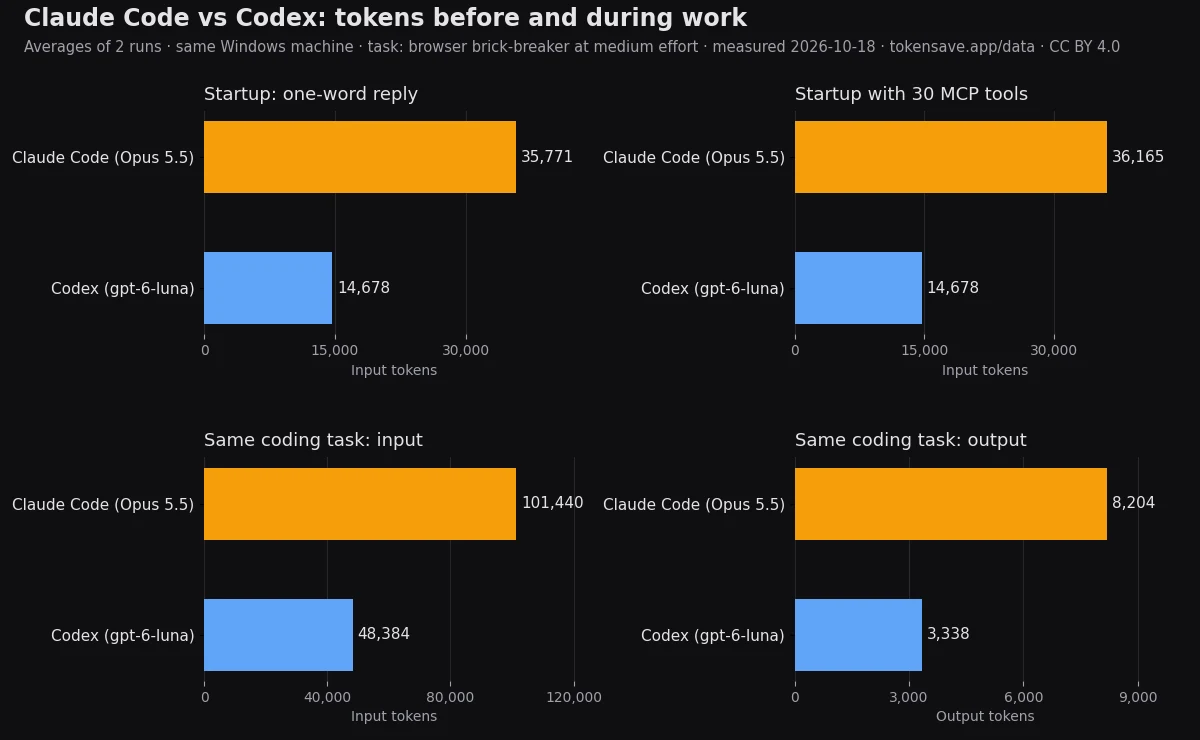
Codex used 52% fewer input tokens and 59% fewer output tokens in TokenSave’s two-run browser-game comparison, according to an October 18 dataset from the usage-tracking product. The hook is a reproducible-looking small experiment with published rows, rather than a broad leaderboard.
The author asked both agents to create a single-file brick-breaker game with two levels, a score, three lives and keyboard and mouse controls. Each run started in an empty folder on the same Windows laptop. Claude Code 2.1.295 used its default Opus 5.5 model; Codex CLI 0.162 used gpt-6-luna. Both coding tasks ran at medium effort.
Claude Code averaged roughly 101,440 input tokens and 8,204 output tokens, versus roughly 48,385 and 3,338 for Codex. Reported mean completion times were 68 and 37 seconds. TokenSave says all four games loaded in a headless browser without errors and displayed the requested levels, score and lives. That check does not establish a complete playthrough or equivalent game quality.
Startup context is part of the bill of materials
The report also measured a one-word reply: 35,771 input tokens for Claude Code and 14,678 for Codex. Adding 30 dummy MCP tools increased those counts by 394 and zero respectively. That does not make actual tool use free: a separate Codex check asking it to list ten tools and call one consumed 47,876 input tokens.
These totals include cached input. They are not counts of entirely new, full-price tokens. Installed skills and plugins also contributed to startup context, and the two agents used different models, tokenizers and pricing arrangements. Claude Code’s API-price figure cannot establish the relative subscription cost of a Codex run under a ChatGPT plan.
There were only two runs per setting and one coding task; Claude Code’s input counts varied substantially between those runs. TokenSave has a commercial interest in usage tracking. AITrending read the English method and published data and inspected the author’s chart, but did not rerun the experiment. The result offers a concrete prompt for measuring your own harness overhead, without establishing a universal cheaper or better coding agent.
Related reading
53 agents, 37 reports and a deletion that never asked permission
Sphinx makes you explain your AI's code before Git lets the push continue