Autolith lets you start an AI agent and leave the terminal behind
Version 0.67.19 adds unattended starts, conversation-prefix resume and clearer session identifiers to the Common Lisp terminal agent.
Autolith 0.67.19 gives its terminal agent a more direct unattended workflow: start a session without attaching, then return using a short conversation identifier. The November 1 release adds autolith --detached and autolith resume PREFIX --detached, with the full conversation ID and running session PID printed for later control.
Autolith is a standalone agent inside a live Common Lisp image. Its project describes an environment that can inspect and modify its own code and state, backed by recovery images. The new release changes how users start and revisit that environment; it does not introduce a new underlying AI model.
Start in the background, attach later
The versioned guide says detached startup works with closed standard input. A later autolith resume PREFIX attaches to a running conversation. Detached resume requires a prefix and, for an already running session, prints its existing PID without disturbing attached clients.
Ambiguous prefixes produce a list of matching conversations with available context, so users can choose a longer identifier. Launch-only overrides such as model or permission changes are rejected when reusing a running conversation. On POSIX systems, the project documents a supervised process group that outlives the terminal; Windows uses a Job Object for the session process tree.
The release also indexes unfinished jobs, releases finished child completion services and bounds workspace permission caches. Its shell-output fixes preserve positive delivery evidence across context compaction, reload and conversation retention, according to the release notes. These are documented changes, not independently measured reliability gains.
A local harness with separate model access
The ISC-licensed project distributes binaries for Linux, macOS, Windows and the BSDs, plus Nix packages. Windows users extract the x86-64 ZIP and run bin/autolith.cmd; existing installations can use autolith update or the in-session (update) command.
Model access remains separate. The guide documents subscription authentication for services including ChatGPT and Copilot, API keys for providers including Anthropic and OpenRouter, and Google Cloud credentials for Vertex AI. Provider eligibility, quotas and charges still apply; the release does not promise free inference.
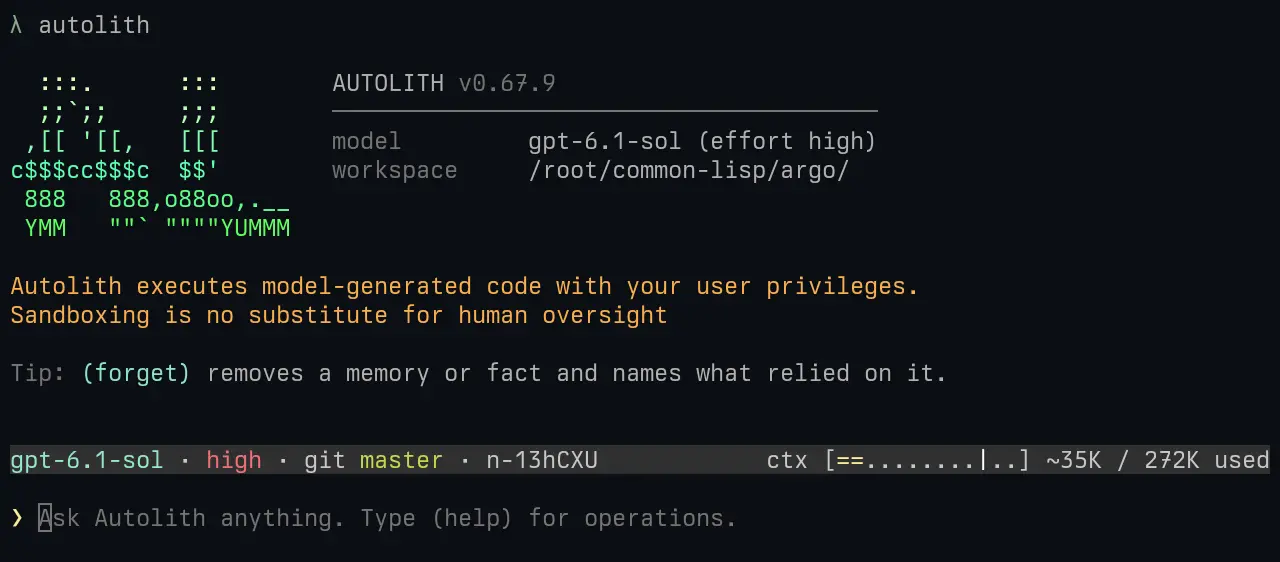
This is also an agent with local execution privileges. The project’s own terminal screenshot warns that model-generated code executes with the user’s privileges. The guide describes command authorization and sandbox modes, while executable user initialization runs with full privileges. Detached startup should therefore be understood as a session-management feature, with permissions determined by the configured environment.
Related reading
Osaurus gives Mac agents finer thinking controls and longer tool chains
AndroidHarness brings installable agent plugins to your phone