Bello 0.8.0 keeps coding agents on the goal and trims their growing context
The October 20 release combines reviewer-controlled Goal mode, optional conversation summaries and event-driven tool scheduling across supported coding-agent backends.
Bello wants a coding agent to keep working until a separate reviewer accepts the original objective. Version 0.8.0, published October 20, packages that Goal mode alongside optional context compaction and Smart Execution, a scheduler designed to spend fewer model turns waiting for tools.
Bello is a community orchestrator around existing coding harnesses and models. It can mix subscription Codex, Claude Code and API-backed Pi roles, with separate choices for the coder, supervisor, reviewer and adversary. The application does not supply a model subscription or make a paid inference run free.
A goal is a review loop, not a completion guarantee
The documented command bello --task TASK.md --goal keeps runtime supervision and completion review enabled. The reviewer returns work for concrete unmet requirements, while the coder maintains a short GOAL_MAP.md of attempts. Completion returns are unlimited in this mode; the optional adversary remains bounded. That can support a sustained task, but does not prove that every task is solvable or put a fixed ceiling on time and model usage. Goal mode is off by default.
No Need For Context, also off by default, summarizes older conversation history while retaining the original task, instructions and complete recent interactions. Its default enabled threshold is 200,000 tokens, with a soft recent-tail target of 10%. The documentation explicitly calls the summary a generative handoff rather than a lossless copy. It changes conversation history, not sandbox or approval permissions.
Schedule tools without changing the model
Smart Execution is on for new configurations and preserves an explicitly saved off setting. It runs independent tool calls concurrently and waits in the program when no result is ready. Conflicting writes and dependent operations remain sequential. The Claude subscription route uses the official Agent SDK with a parallel-tool wrapper; the native Codex route requires a compatible helper.
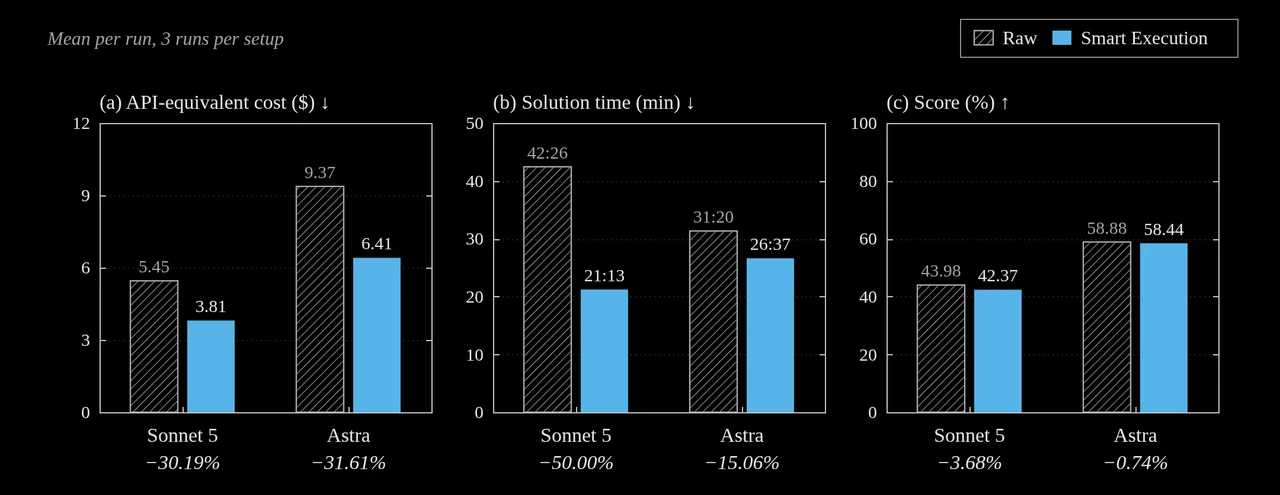
The maintainer’s small comparison used three runs per model and setup. It reports lower API-equivalent costs and shorter solver times for Sonnet 5 and Astra, alongside slightly lower mean scores. Those are author-run measurements, not an AITrending replication or a promise of universal savings.
Install with pipx install bello, check readiness with bello doctor, or update an existing installation with bello update. Python 3.11+, Git and platform-specific sandbox setup are prerequisites. Users supply their own account credentials; Claude support needs the claude extra. Managed Codex helpers target Apple Silicon, Linux x86_64 with glibc 2.35+, and Windows x86_64. They are modified helper builds, not an official OpenAI feature or a replacement for the global Codex installation.
Related reading
Codex Security's GitHub Action opens scans to Bedrock, OpenRouter and Fireworks
Orca brings Antigravity into native chat and makes remote agents less forgetful