Bernstein puts Claude Code and Codex behind one auditable task queue
The open-source coordinator pairs parallel CLI agents with Git worktrees and offline-verifiable records; a fresh Hacker News discussion puts the existing project back in view.
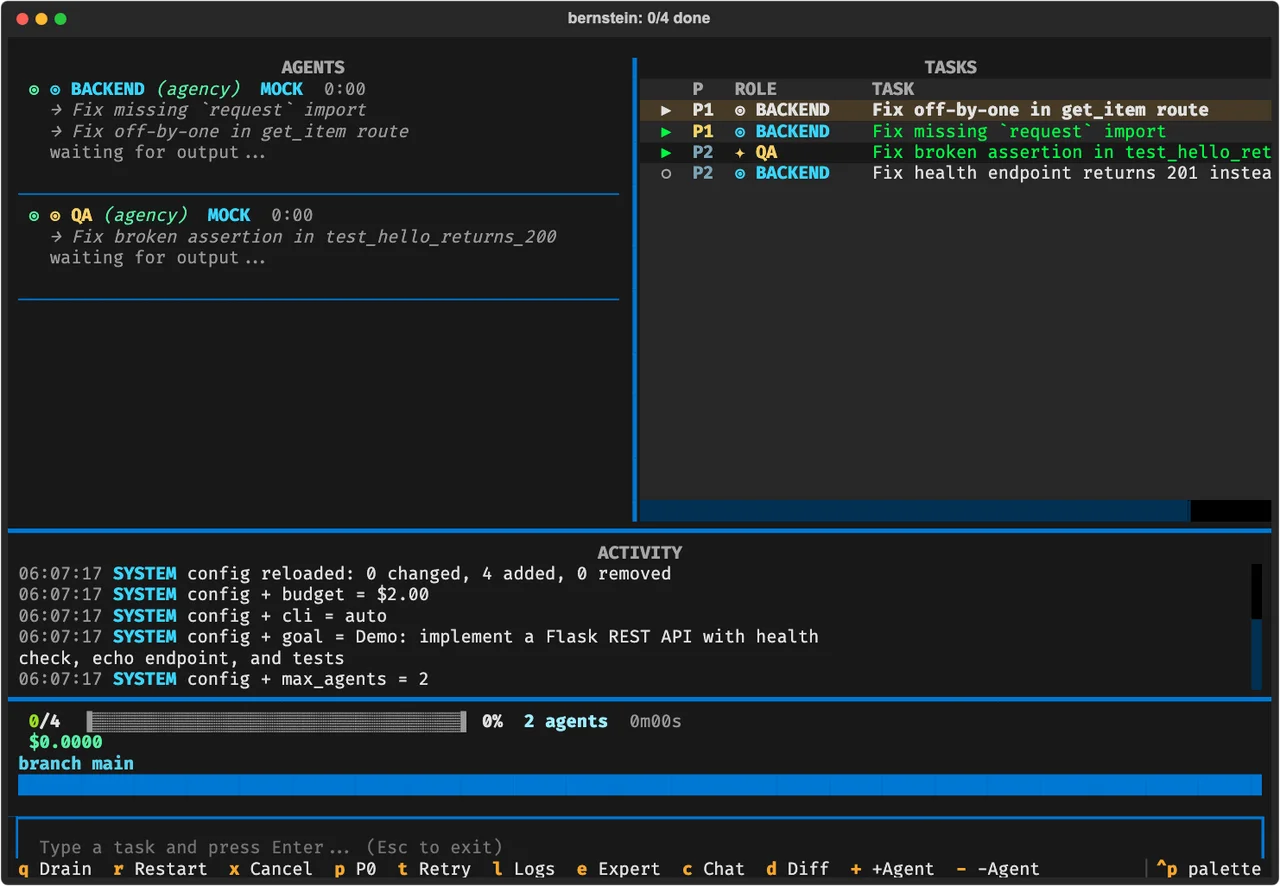
Bernstein offers a concrete answer to a familiar multi-agent problem: several coding assistants working at once, with one place deciding which tasks run and which changes can merge. The Apache-2.0 project calls itself a governance layer for AI agents. Its documented workflow combines a deterministic Python scheduler, separate Git worktrees and test-based gates around agents including Claude Code, Codex and Gemini CLI.
An English Hacker News submission on October 29 supplies the current discussion hook. Bernstein is an existing project: its website dates the original 1.0 introduction to March 29, 2026. Today’s submission is not evidence of a new launch or measured adoption surge. One commenter welcomed deterministic, verifiable harnesses; that reaction is discussion, not independent validation of the software.
Models do the work; code controls the queue
The README describes four stages: decompose a goal, spawn workers, verify their outputs and merge passing work. Model calls can help plan tasks or perform optional selection and review. The scheduling loop itself is Python. That distinction makes the coordination graph inspectable without claiming that a fresh model call will always generate identical code.
This is an orchestration layer around installed agent CLIs, rather than a new model or a fork of Codex. Installation starts with Python 3.12 or newer and uv tool install bernstein or pipx install bernstein, followed by bernstein init inside the target repository. The project recommends bernstein doctor to check installed and authenticated agent backends. Operators retain responsibility for provider accounts, credentials and applicable model charges.
Each coding task normally gets its own worktree. Verification uses the checks a repository actually supplies, such as tests, lint and type checks. The project’s limitations page explicitly notes that weak tests reduce confidence in completed work. Worktree separation also does not establish an operating-system security boundary: stricter filesystem containment is a separate, opt-in sandbox configuration.
A receipt proves specific things
Bernstein documents replay journals, lineage records and an optional HMAC-chained audit log. Signed run receipts can be checked offline. The README makes a useful qualification: checking a receipt without pinning the operator’s public key establishes internal integrity, not the signer’s identity. Proving that an embedded journal state is the complete finished journal additionally needs an independent head/count seal.
That makes Bernstein worth evaluating for teams trying to coordinate existing agents and preserve inspectable evidence of their runs. It does not make passing tests a guarantee of correct software, or a signed record a guarantee of a good decision. The project labels itself beta, warns that interfaces can change and recommends version pinning. AITrending reviewed its English documentation and discussion, but has not run the orchestration or reproduced its verification claims.