Claude Code's team moved review to agents, then capped the review loop
Anthropic describes risk-based human approvals and a three-round review cap after one pull request went through more than fifty overnight rounds.
The reviewer needed a stopping rule
Claude Code’s team says it moved most code reading to machines, but discovered that an agent author and an agent reviewer could keep each other busy indefinitely. One CLI pull request went through more than fifty rounds of review and fixes overnight before its author stopped it.
In an October 15 engineering account, Addy Osmani, Morgan Westlee Lunt and Qing Wang describe the response: after three rounds, the reviewer asks the author to step back and reconsider the approach. Later passes focus on the new diff, avoid repeating findings and flag a class of bug so the author can fix all instances together.
The team says about 59% of what that runaway reviewer kept flagging was code already present at its first pass. Repeated reviews were uncovering more old issues rather than consistently finding newly introduced bugs.
Human approval follows the change’s risk
The documented process starts before a pull request: tests, build and lint, followed by a fresh-context agent reviewing the diff. On every PR, parallel bug-hunting agents and separate verifiers produce findings, while security gets another pass. Open findings from either review block merging until fixed or resolved with a reason.
Low-, medium- and high-risk changes require zero, one or two human approvals respectively. Lighter paths are restricted to trusted authors; sensitive paths and CI workflow files still need a person. A bot approval cannot fill a required human slot, and approval applies to a particular commit. The person directing an agent remains accountable for the change.
The merge queue reruns checks against current main. Internal use, feature flags, gradual releases and rollback provide additional defenses after review.
Company results, with a product boundary
Anthropic reports that merged PRs in Claude Code’s codebase more than doubled from June to September while the share reverted fell by more than 40%. After the convergence changes, it reports first-round passes rising from 65% to 78%, and the share needing at least five rounds falling from 8.9% to 1.5%. These are company-reported internal results, not an independent comparison or a guarantee for other teams.
The public Code Review product, now generally available on Team and Enterprise plans according to the account, posts findings rather than approvals. Anthropic’s internal low-risk automatic merging goes further; buying the review product does not establish that a customer’s approval rules change.
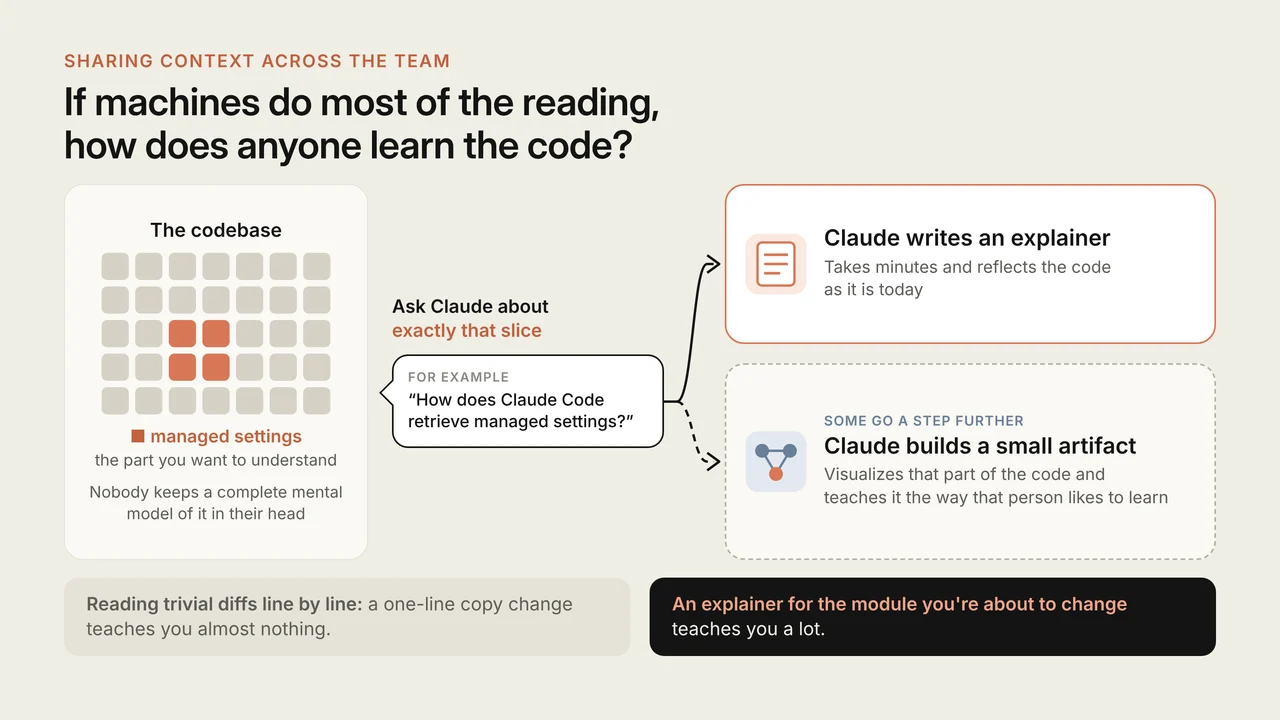
The account also leaves an open question: shared codebase understanding has no formal replacement process. Engineers ask Claude for focused explainers or visual artifacts when they need to understand a module, rather than claiming everyone retains a complete picture from automated review.