Anthropic says Claude traced decades-old ECDSA seeds to Unix timestamps
An internal research model reportedly explained the origins of five NIST prime-curve seeds in under half an hour. The finding is about provenance, not broken encryption.
A cryptographic mystery gets a mundane answer
Anthropic says Claude explained the origins of five NIST elliptic-curve seeds in under half an hour: they were outputs of an old C-library pseudorandom number generator initialized with Unix timestamps. The October 16 account credits an internal research model, without naming a publicly available model version.
The mystery concerns the parameters behind widely used ECDSA digital signatures. The standards published seed values supplied by the NSA, but not how those values were chosen. That gap encouraged years of speculation, including an unsuccessful search for a humorous passphrase whose hash might produce the seeds.
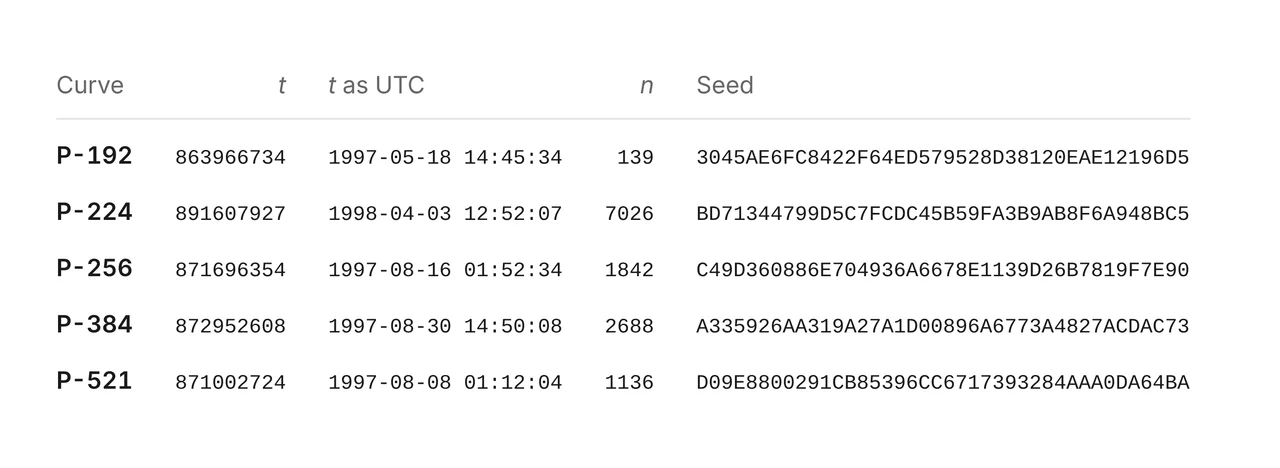
According to Anthropic, Claude instead recognized the behavior of lrand48, a generator shipped in 1990s C libraries. It recovered internal generator states from fragments of the published seeds, then stepped those states backward toward their initialization. For the prime curves, the recovered values correspond to dates between May 1997 and April 1998.
Reproduction is different from a security break
The announcement publishes code and expected outputs for the NIST P-192, P-224, P-256, P-384 and P-521 seeds, alongside other curve parameters. In the P-256 example, the standardized seed appears at candidate 1,842 in the reconstructed run.
This is not a recovered signing key, a new attack or a demonstrated weakness in ECDSA. The old generator was used to choose public parameters; identifying it does not show that the secret keys used with those curves are generated the same way. Anthropic interprets the reconstruction as evidence against intentional weaknesses in the selected curves. That interpretation remains the researchers’ assessment, rather than a proof of every historical selection decision.
Some origins remain unexplained
Anthropic also reports reconstructing the base points for P-192 and five ANSI example curves using the FreeLIP generator. It did not explain the base points for P-224, P-256, P-384 or P-521, or those of the NIST binary curves. The B-163 binary seed remains unresolved too.
There is another caveat: some apparently viable curve candidates were skipped. The team does not know why, although it argues the small number of skipped candidates makes deliberate weakening implausible. English Hacker News commenters debated that distinction between reconstructing a generator and explaining selection criteria, as well as access to research models. Those comments are discussion, not additional verified cryptographic findings.
The news is a concrete historical reconstruction with public reproduction material, not a reason to treat every question about curve provenance as settled.