Anthropic says Claude found a quantum design with 17x fewer gates
An evaluator-guided study reports better circuit designs across eight tasks, including a new modular-inversion approach and a cheaper quantum decoder.
Circuit designs improve inside a scored feedback loop
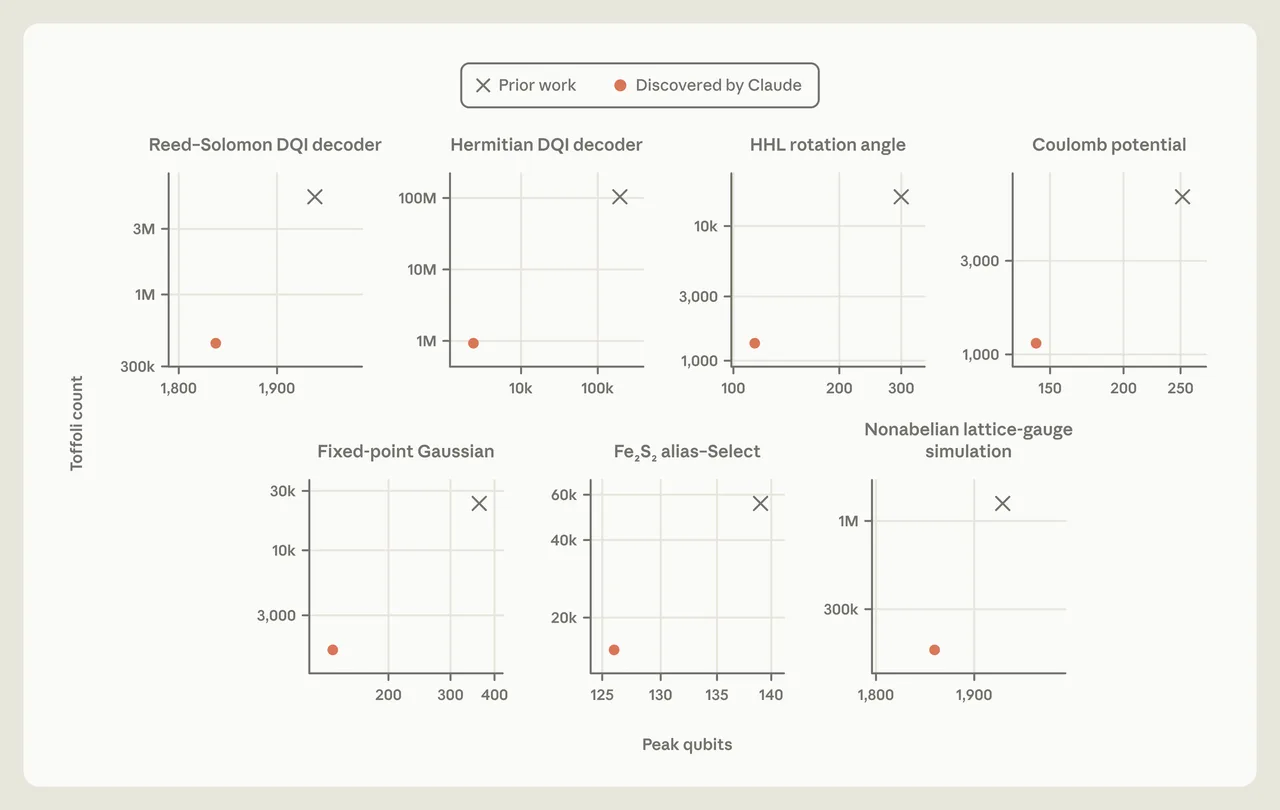
Anthropic reports that Claude Mythos 5 designed quantum circuits that improve on previously published resource trade-offs across eight computational tasks. The study pairs a model proposing circuit code with an external program that checks correctness and scores the required qubits and gates.
The accompanying paper describes a precise split: seven tasks reduce both Toffoli-gate and qubit counts, while the eighth discovers a new architecture for modular inversion that expands the available trade-offs. These are circuit-design results reported by the researchers, not a demonstration that present-day quantum hardware now runs the target applications.
The work was led by Andi Gu through Anthropic’s STEM Fellows Program, with Alek Kemeny and collaborators Susanne Yelin and Mikhail Lukin. The paper was submitted October 15; Anthropic’s explanatory announcement followed October 16.
The 17x result trades some space for time
One highlighted task is elliptic-curve point addition, whose cost is dominated by modular inversion. Anthropic says Claude worked for 53 hours with minimal human input, including the initial brief and occasional prompts to broaden its search.
The resulting approach makes the classical divsteps method practical in reversible arithmetic by reconstructing branch information instead of always storing its history. Anthropic says Claude derived mathematical identities, checked them numerically and formalized a claim in Lean.
Against the smallest previous design, one new circuit uses 12% more qubits but 17x fewer gates. That qualifier matters: the headline gain is not a simultaneous 17-fold reduction in every resource, nor an end-to-end speed measurement on a quantum computer.
A second example replaces a Reed-Solomon decoder’s underlying method and reconstructs temporary state to reduce storage. Anthropic reports a 12-fold gate-count reduction against the prior construction for this decoder, a costly component in decoded quantum interferometry. Its memory budget allows a small failure rate within the task’s tolerance.
Human framing and evaluator quality still matter
The search was not entirely hands-off. Researchers required several distinct approaches in parallel and sometimes prompted Claude to explore more broadly. Anthropic also observed conservatism and repeated checking that could slow the search.
The practical research pattern is promising: express a design as code, validate it externally, then score a concrete cost. The claim that this could bring useful quantum computers closer remains a projection. Error correction, hardware control and other system components still have to work alongside the improved circuits.