Dharma says its 2B field extractor beats frontier models on a document test
The specialized model turns document images into typed JSON, with Dharma reporting higher scores and lower compute cost on its own 546-document evaluation.
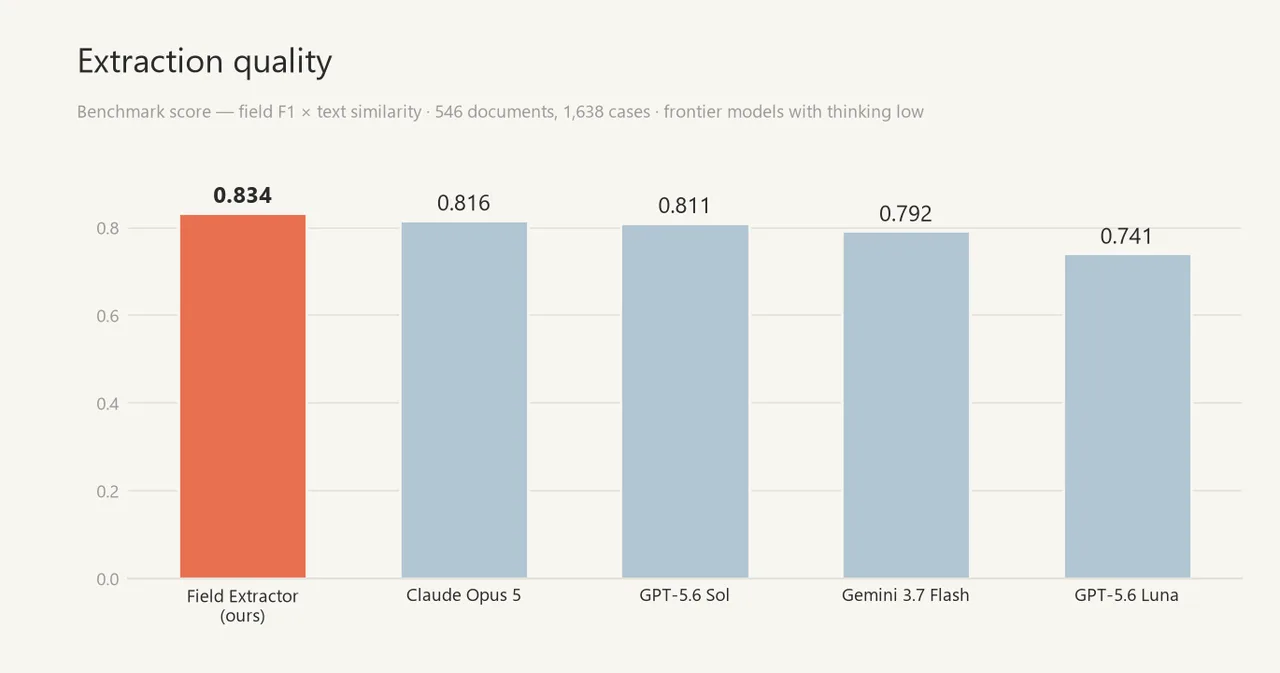
Dharma-AI says a 2-billion-parameter document model outscored all four frontier configurations in its field-extraction test, while using less compute spend per extraction. Its November 4 report introduces Field Extractor, which returns the specific values a business needs as JSON rather than transcribing an entire page.
That is a concrete distinction for invoice processing: a system may need a supplier, invoice number, due date and total, not a block of text that another component must map into database columns.
Ask for everything, or name the fields
According to Dharma, open extraction finds structured fields from page layout and context. Schema-directed extraction uses the caller’s key names and requested string, number or boolean types, including nested tables. The team says absent fields return null; that is documented behavior, not a guarantee AITrending has independently tested.
Dharma describes training a LoRA adapter on 43,384 examples over its DharmaOCR-LITE v1.1 base, mixing English, Brazilian Portuguese and other-language documents. The report is written in English; its training mix should not be confused with evidence of equal performance in every language.
What the reported win measures
The vendor’s evaluation covers 546 documents in three scenarios, producing 1,638 cases: open extraction, a partial schema and a schema containing nonexistent fields. Its composite score combines field-level F1, text similarity and valid-JSON output. Dharma reports 0.834 for its model, compared with 0.816 for Claude Opus 5 and 0.811 for GPT-5.6 Sol in the tested configurations.
The comparison uses low reasoning settings, with adaptive effort for Claude. It supports a result on this task and setup, not a claim that the small model is generally more capable. AITrending has not reproduced the evaluation.
Dharma also reports roughly 6 to 147 times lower cost than the tested APIs. That compares estimated GPU time on one L40S at $2.24 per hour with measured API tokens at provider list prices. It is not a customer price quote; deployment utilization, hardware and latency requirements change the economics.
For integration, the public API schema documents authenticated synchronous PNG/JPEG requests and asynchronous PDF processing. Selecting the field-extractor model returns fields, with an optional JSON schema. Access requires portal credentials or an API key from Dharma. The reviewed report does not establish downloadable weights or a license for this new checkpoint, and its benchmark cost is separate from service billing.
Related reading
Kino puts your team and coding agents on the same video timeline