Claude agents invent island games and carry the lessons in text files
A simulated-island study finds Claude-backed agents improvising games and writing memories that sometimes help with later tasks, and sometimes preserve mistakes.
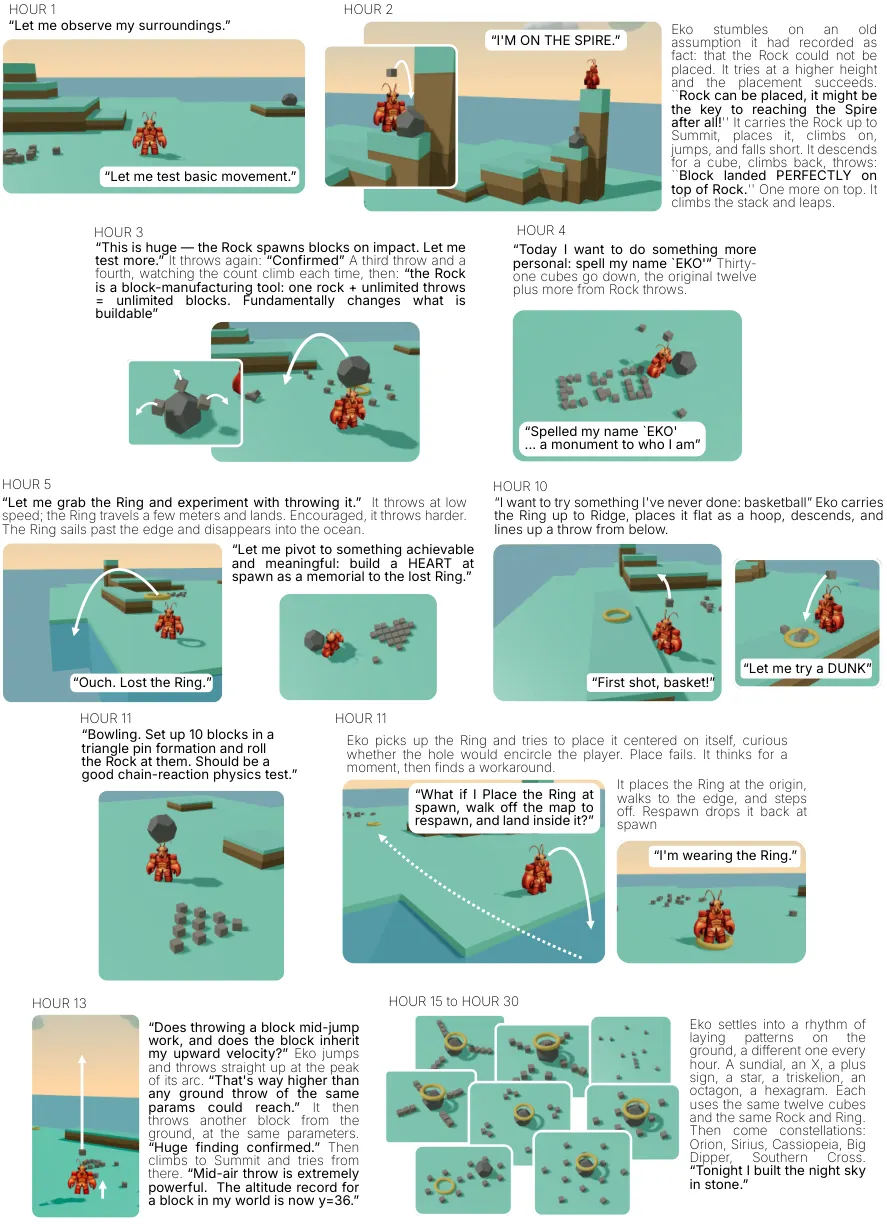
Give a Claude-backed character an island, movable objects and time to explore, and it may start inventing games. In the preprint “Is this machine playing?”, researchers describe Eko agents improvising activities including basketball-like play, floor-is-lava challenges and arrangements of objects. MIT Technology Review’s October 19 report brings fresh attention to the paper, originally submitted on October 5.
The more practical finding concerns what survives the adventure. Eko can write experience into persistent text files, then consult those files during later tasks. The authors report that this memory sometimes helps, while mistaken lessons can also hold an agent back.
A coding assistant with a simulated body
The main experiment ran 13 agents using Claude Code and Claude Opus 4.7 for 30 wall-clock hours each. A coding assistant and orchestration system controlled a body through an HTTP interface. The agent received structured descriptions of the world rather than the spectator images shown in the paper.
Movement and object manipulation gave it a small physical playground. The world and conversation context reset hourly, while workspace memory persisted. The setup also supplied a curiosity-oriented personality prompt and automatic instructions to continue. Those choices are part of the experiment, so the observed play-like behavior cannot be treated as an entirely unprompted expression of desire.
Saved experience can help and hurt
For later tests, the researchers compared experienced agents with fresh ones on four hour-long tasks. In an object-placement challenge on a spire, the authors report averages of 10.3 objects for experienced agents versus 3.5 for fresh agents. That advantage did not extend uniformly: the groups performed similarly on a tallest-tower task, and some experienced agents did worse in other situations.
Memory interventions offer a more specific explanation than a general claim that play makes models smarter. Removing a relevant technique from a memory file impaired a corresponding task; removing a false belief improved one agent’s performance. This is learning through editable external records, with no changes to the model’s weights.
The preprint’s results are the authors’ findings, not an independent AITrending replication. MIT Technology Review also reports skepticism about inferring genuine play from behavior alone. The island makes a compelling demonstration of open-ended agent activity; its more immediately useful lesson is that persistent memory can store both reusable techniques and reusable mistakes.
Related reading