Google turns Antigravity into a science workbench, with an antimicrobial lead headed to lab tests
A new Biomolecular Structure Viewer lets scientists and agents share protein annotations. Google's peptide candidate is still undergoing wet-lab validation.
A scientist and an agent can inspect the same protein
Google is extending Antigravity’s agentic development environment into biological research. In an October 15 walkthrough, DeepMind introduced a Biomolecular Structure Viewer embedded in the workspace and described how researchers used the platform to identify an antimicrobial peptide candidate that is now undergoing wet-lab validation.
The viewer gives the researcher and agent a shared 3D representation of a protein. Google says the agent can retrieve predicted structures and highlight regions while explaining a hypothesis. The scientist can mark residues or pin notes to a binding pocket, and those annotations flow back to the agent. That makes a question about a particular structural feature part of the ongoing conversation, rather than requiring the user to describe its location again in text.
Database searches become one guided workflow
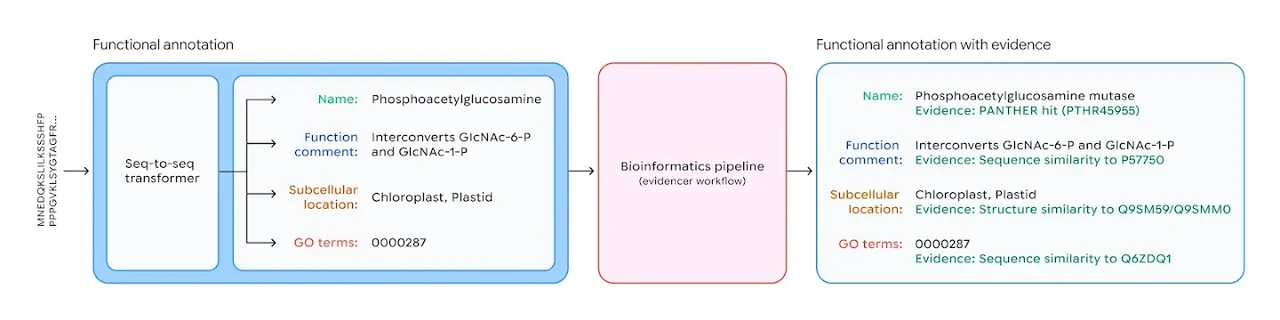
The example combines ProtNLM, Google’s protein-function prediction model, with searches across UniProt, sequence comparisons against curated Swiss-Prot entries, AlphaFold structure retrieval, genomic-neighborhood inspection and literature review. Antigravity is the workbench coordinating those steps; it is not a replacement name for ProtNLM or AlphaFold.
Google describes a researcher steering the questions and evidence collection while the agent runs the cross-database work. The walkthrough narrows the search to a 97-amino-acid candidate from the Lactococcin 972 family in Streptococcus pseudopneumoniae. Structural similarity and nearby genes support the researchers’ hypothesis that it belongs to a bacteriocin system. The agent then helps prepare an experimental plan covering expression, antimicrobial testing and toxicity assessment.
A plausible lead, not a proven antibiotic
The company says this candidate, alongside others found through the same pipeline, is in wet-lab validation. Predicted antimicrobial activity, novelty and a proposed mechanism remain computational findings and hypotheses until experiments establish them. The post reports no completed efficacy or safety result and does not demonstrate a treatment ready for patients.
The immediate development is a new shared visualization tool and a documented, human-guided research workflow. Google’s claim that it compresses days of fragmented database triage into one session is a first-party account, not an independently timed comparison. The announcement also does not establish a separate price or a universal access schedule for the science viewer.
Related reading