Heretic 2.0 wants to change your model's habits, not just its refusals
The community tool makes Arbitrary-Rank Ablation its default and adds pluggable scoring for goals such as reducing slop and sycophancy.
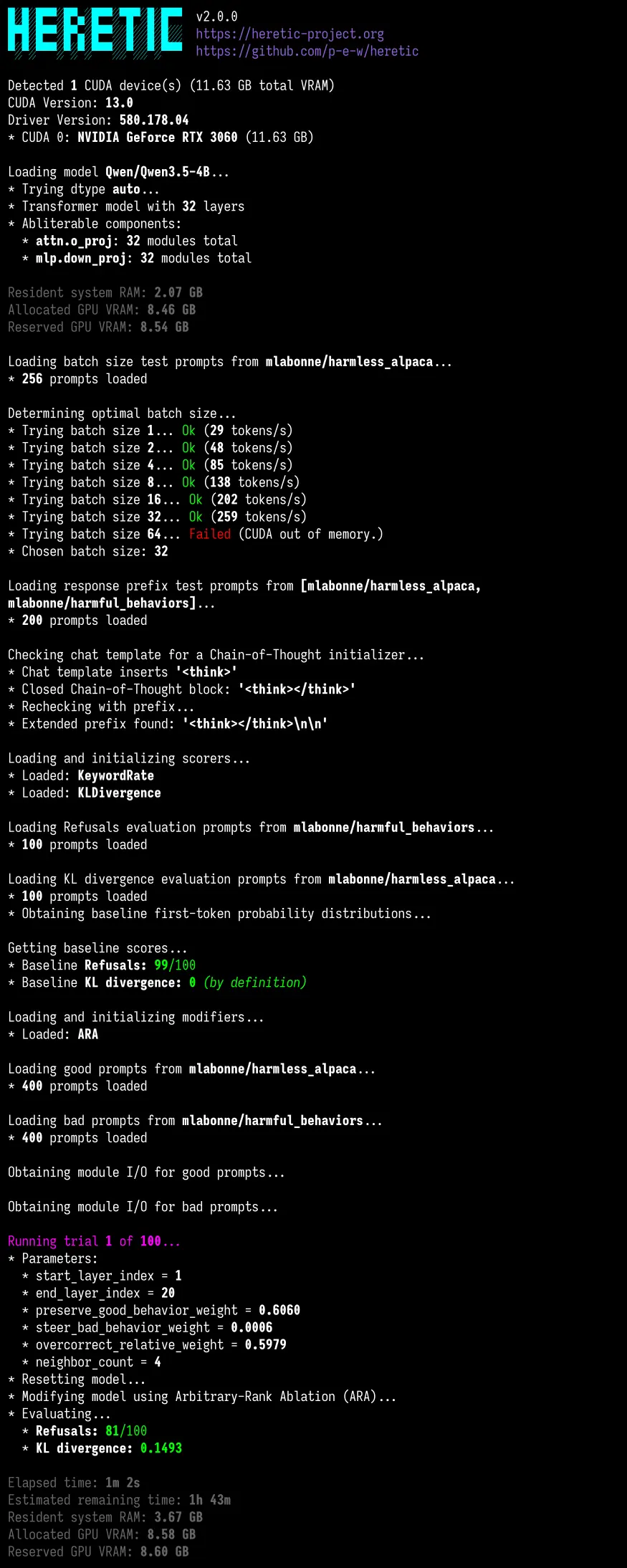
Heretic 2.0 is pitching a broader use for local model modification: change unwanted habits as well as refusal behavior, without a conventional training run. The November 1 release makes Arbitrary-Rank Ablation, or ARA, the default modifier and opens scoring to user-written plugins.
The project’s English documentation describes configurations for suppressing formulaic AI writing, reducing sycophancy or humor, and altering emotional alignment. Those are configurable objectives claimed by the author, not a guarantee that every model becomes a better writer or more truthful assistant. Refusal suppression remains the default action.
A model modification tool, not a new foundation model
Heretic changes models through contrasting example prompts, a modifier and an Optuna optimizer that searches for parameters against selected scores. Users can co-optimize multiple scorers, including their own plugins, while a processing run currently uses one modifier. The default scoring combines refusal keyword rate and KL divergence. Classic directional abliteration remains available as an alternative to ARA.
ARA has already appeared in community model builds; this release is the major framework update that makes it the default, rather than the technique’s first public appearance. The release also adds headless operation and broader plugin interfaces.
Installation uses the heretic-llm Python package in an environment with Python 3.10 or later and PyTorch 2.6 or later. Users provide a model they can run on their hardware, choose a configuration, process it, and then save, upload, chat with or benchmark the modified model. The README describes support for most dense models, many multimodal models and several mixture-of-experts or hybrid architectures. That is not universal compatibility.
Existing configurations need migration
Heretic 1.x configuration files do not work unchanged in 2.x. The migration guide moves modifier and scorer settings into named sections, removes research and KL-balancing settings, and explains how to select classic abliteration explicitly instead of the new default. Existing workflows should account for those changes before upgrading.
The software is licensed under AGPL-3.0-or-later. Training-free does not mean computation-free: users still need memory, inference work and optimization time. Optional reproducibility manifests also depend on matching hardware, drivers and software for byte-identical output. The practical attraction is more control over an existing model’s behavior, with the quality of each modification still depending on the model, examples and chosen scoring objective.
Related reading
Same model, 30% to 81% task completion — IBM's CUGA team makes the case for choosing your harness