Hugging Face shrinks models to catch silent Transformers bugs on a CPU
Model Integration Contracts pair frozen test fixtures with runnable examples and human-reviewed outputs. An author-reported UMT5 replay caught a bug that let training peek at future tokens.
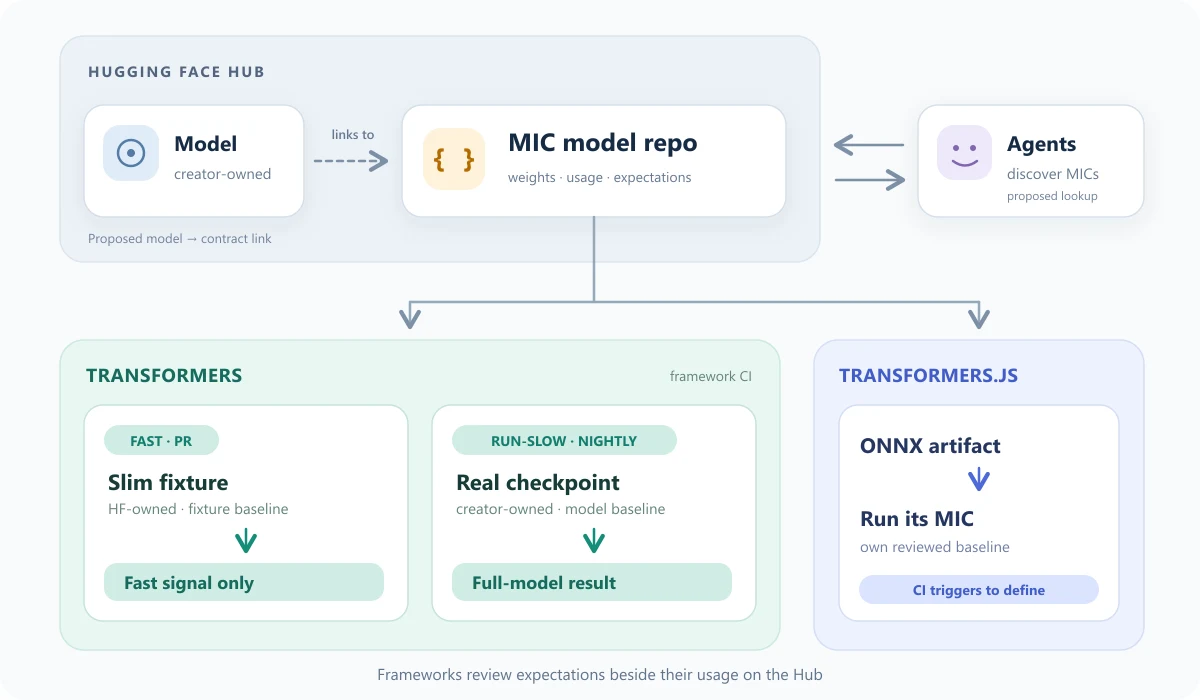
Hugging Face is proposing a cheaper way to catch model bugs before they reach Transformers users: run small, frozen versions of model architectures against real usage examples on a CPU. Its November 3 introduction calls the format Model Integration Contracts, or MICs, and uses a silent UMT5 training regression to show why merely loading a model is not enough.
According to Tarek Ziadé’s post, a July 30 change enabling scaled dot-product attention for T5 allowed UMT5’s decoder to attend to future tokens. Training could effectively peek at the answer without crashing. The regression was fixed September 28. In the team’s later replay, a small UMT5 fixture flagged it throughout that interval.
The reported proof run took 13.4 seconds for the selected T5 contract’s runner step on CPU, excluding setup. That is a specific author-measured test, not a claim that every model or complete CI run finishes in that time. The experimental UMT5 fixture used 66 MB of weights compared with 1,227 MB for its source checkpoint.
A contract has three parts
A MIC combines a fixture, an executable Markdown usage path and human-reviewed baselines. The fixture shrinks a real checkpoint’s configuration while keeping its different layer kinds, and copies tokenizer and processor files unchanged. The example exercises something a user actually does, such as generation or a training step, then compares outputs with the reviewed expectations.
The attention path proved essential: the UMT5 contract using the default SDPA path caught the bug, while an eager-only variant missed it. A tiny model helps only when the test reaches the relevant behavior.
An LLM can draft contract code and manifests through the tmic CLI, but humans approve changed expectations. The documented local workflow installs transformers-mic[runtime] and Hugging Face’s doc-builder, signs into Hugging Face and runs tmic run org/model --local-only --fixtures-only --no-history --bill-to ''. It stops before uploading. For a new model, the drafting call uses Inference Providers billed to the user’s own account.
Fast feedback has limits
The repository’s November 2 status says the contracts job runs on Transformers pull requests and reports failures without blocking them. It resolves the fleet dataset’s main revision at the start of a run and logs that revision; the separate Transformers-side lock file is not yet read by the job. Coverage, false alarms and review workload remain open questions.
These fixtures are test instruments, not smaller production models with equivalent abilities. The post gives a Llama 4 Scout example shrinking 108.6 billion parameters to 44.7 million, but that reduction is for exercising architecture and API behavior. Both random and overfit Whisper fixtures missed a real assisted-decoding bug exposed by the original checkpoint.
The practical proposal is to add cheap, behavior-specific checks ahead of expensive full-model tests. Hugging Face says fixtures will not replace those tests, and AITrending has not independently rerun its experiments.
Related reading
Zeroshot lets coding agents work in folders without Git
Same model, 30% to 81% task completion — IBM's CUGA team makes the case for choosing your harness