IDM targets better text in two-step images, with code out and weights still to come
The authors report stronger dense-text rendering at two network evaluations using the generator's own features; downloadable IDM checkpoints remain listed as coming soon.
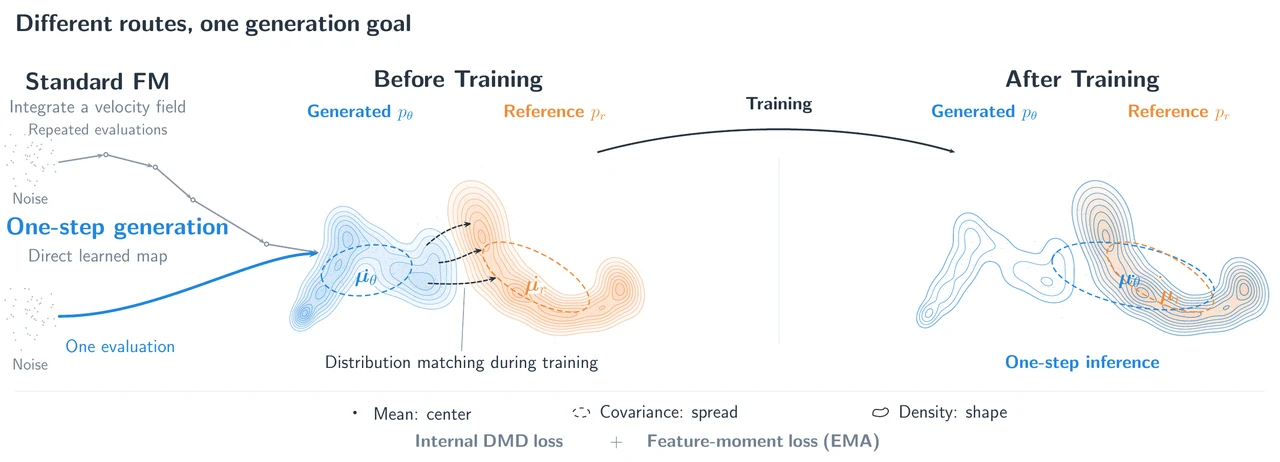
Fast image generation still has to spell the words on the poster. Intrinsic Distribution Matching, or IDM, tackles that problem by training a generator with statistics from its own internal features. The researchers report improved dense-text rendering at two network evaluations, while releasing inference code ahead of the model weights.
The October 29 paper evaluates the approach on Z-Image-Turbo 6B and Qwen-Image 20B, using full-parameter tuning and LoRA adapters. Its public README describes both one- and two-evaluation sampling. These are research results reported by the authors, not measurements reproduced by AITrending.
Better text at a matched sampling budget
For the Z-Image comparison at two evaluations, the authors report 90.20% on LongText-EN, versus 89.88% for Z-Image-Turbo++ and 88.76% for APEX. That is a modest English-text gain over the strongest of those references, rather than evidence of flawless typography. The eight-evaluation Z-Image-Turbo reference still scores higher on LongText-EN, at 91.74%, and APEX leads IDM on DPG-Bench in the listed comparison.
IDM retains the full distribution-matching correction and adds a loss matching feature means and per-coordinate standard deviations. The features come from an exponential-moving-average copy of the generator, avoiding an external feature encoder. The authors also provide controlled ablations with shared training settings; comparisons against other published models use different settings and data.
Code today, checkpoints later
The reviewed repository includes inference scripts and setup instructions for Python 3.10 or later on a CUDA machine with sufficient memory. It explicitly marks IDM checkpoints coming soon. Loading ordinary base-model or APEX weights does not reproduce the claimed IDM results.
The code is Apache 2.0 licensed, while base-model and future checkpoint licenses apply separately. Readers can inspect the method and inference implementation now; a ready-to-download IDM model, an independently verified quality gain and a consumer-hardware speed claim are not established by this release.