Kling says better AI video starts with a better semantic contract
A new technical report traces video failures through captions, prompt rewriting, perceptual encoders and evaluation, rather than treating every bad shot as a rendering problem.
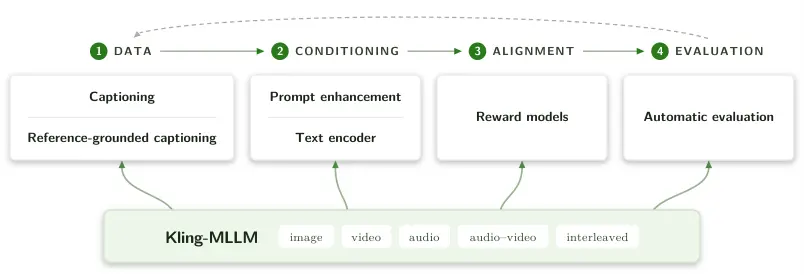
Kling’s team argues that making a video look better is no longer enough: a generator also needs a precise account of what should happen, what should stay the same and how success will be checked. Its November 3 technical report lays out the understanding stack behind those decisions.
The useful shift is diagnostic. A character changing identity or a requested action disappearing might originate in training captions, the representation passed into the generator, a reward that favors stillness, or an evaluator that never checks the event. The authors argue that a bad output alone does not identify which part failed.
Captions as an executable specification
The report describes captions as a semantic contract. Subjects need consistent names, shot boundaries need timestamps, visible text needs faithful transcription, and actions need their order and resulting states. Generic words such as cinematic cannot substitute for concrete camera, lighting and spatial instructions.
The team also warns against filling every field mechanically. Audio descriptions should be included only after inspecting an audio track; unsupported speech or sound effects introduce contradictory supervision. Dense generation captions and short retrieval captions serve different jobs.
That contract extends to reference material: instructions must make clear which subject or property a reference controls, rather than assuming a generator will resolve ambiguous bindings.
Repair the story before translating the prompt
The prompt-enhancement design separates two tasks. An agentic step can resolve an inconsistent plot and retrieve useful caption examples. A basic enhancement model then translates that specification into the caption style the generator learned.
The authors give examples of the upstream problem: a character’s clothing changes between paragraphs, a scene is both indoors and outdoors, or too many events are planned for the available duration. Their proposed refinement rules favor minimal edits and recording conflicts, rather than silently inventing a new premise.
The rest of the stack includes perceptually trained text encoders, an explainable reward model for localized critiques and a faster decision reward model for multidimensional scoring. Evaluation should test the task’s actual constraints and expose scoring shortcuts, the report argues.
These are Kling Team’s observations and experimental conclusions, not independently reproduced results from AITrending. The publication discloses engineering methods across successive Kling generations; it does not by itself announce new downloadable weights, pricing or a public model endpoint.