PDRVLA teaches robot actions without generating video at run time
Researchers train compact physical tokens to predict action consequences, then remove the auxiliary video model when the robot policy runs.
A robot policy can learn from predicting what happens next without generating a video every time it acts. That is the design behind PDRVLA, a new research paper that trains compact physical representations and removes the auxiliary video machinery at execution.
The practical attraction is the separation of training supervision from the deployed action path. It is an architectural proposal, not a demonstrated universal speedup or a claim that a robot now understands all of physics.
Physical tokens stay; video prediction goes
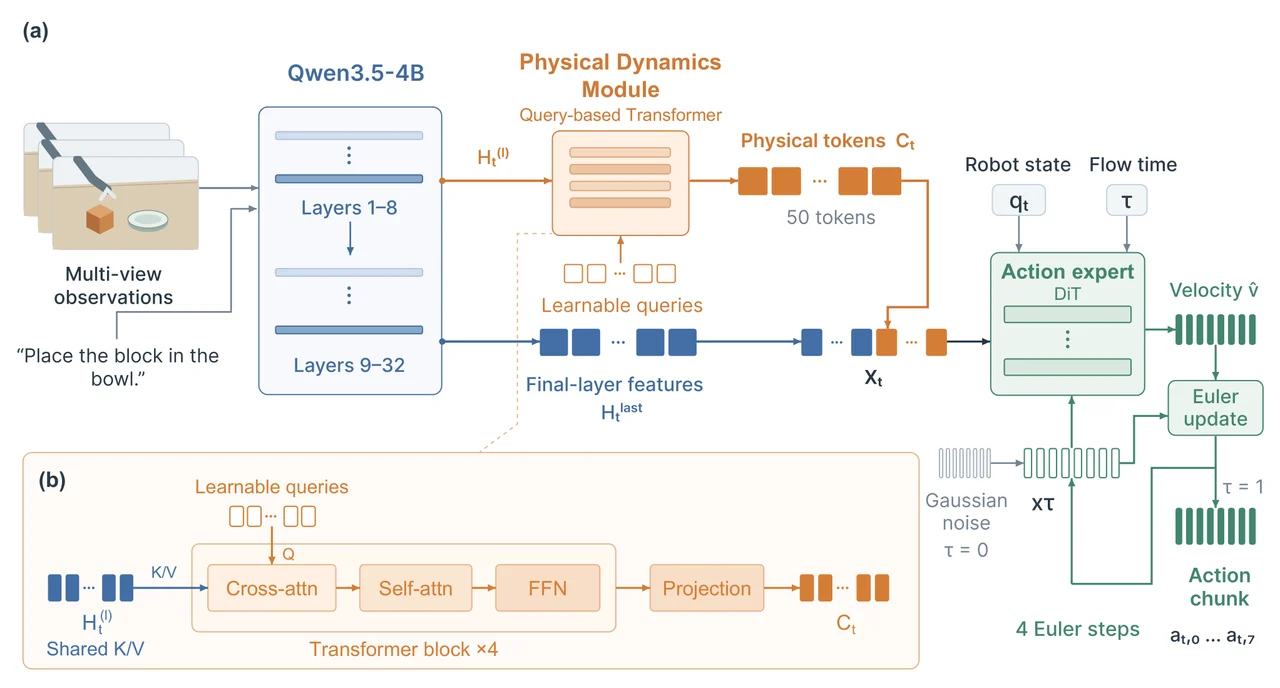
The authors build on Qwen3.5-4B and extract 50 physical tokens through a 57.3-million-parameter module. During training, those tokens help predict future RGB, depth and optical-flow features, with assistance from a frozen LingBot-Video-Dense-1.3B model.
At execution, the video model and prediction heads are removed. The learned tokens instead join the vision-language features and robot state as inputs to an action expert. The system retains a representation shaped by future-prediction tasks without running the auxiliary video generator as part of every action.
Strong simulation results, with uneven wins
The paper reports average success rates of 99.3% on LIBERO, 89.9% on LIBEROPlus, 93.6% on RoboTwin 2.0 and 81.5% on SimplerEnv. These are the researchers’ simulation results after benchmark-specific fine-tuning, not zero-shot physical-robot tests.
The comparisons also use baseline results from cited papers or official repositories under their respective training and evaluation protocols. They should not be read as identical controlled reruns. PDRVLA does not lead every task: its reported 97.6% on LIBERO Long trails LingBot-VA’s 98.5%, for example.
A research direction to watch
The paper first reached arXiv on October 27 at 15:09 UTC. Its appearance in the refreshed community paper candidates provides a current discovery signal, not proof of viral growth or a later release date.
For readers following robot foundation models, the useful idea is learning physical supervision into a compact action representation. AITrending has not reproduced the evaluations, and review did not establish a downloadable code or weights release. Real-robot transfer and deployment latency remain separate questions from the reported simulation success rates.
Related reading