RynnUnify opens a 2,000-question test for reasoning beyond the camera frame
The newly published research package pairs embodied-understanding questions with images and stored rollout videos; its underlying paper dates to October 23.
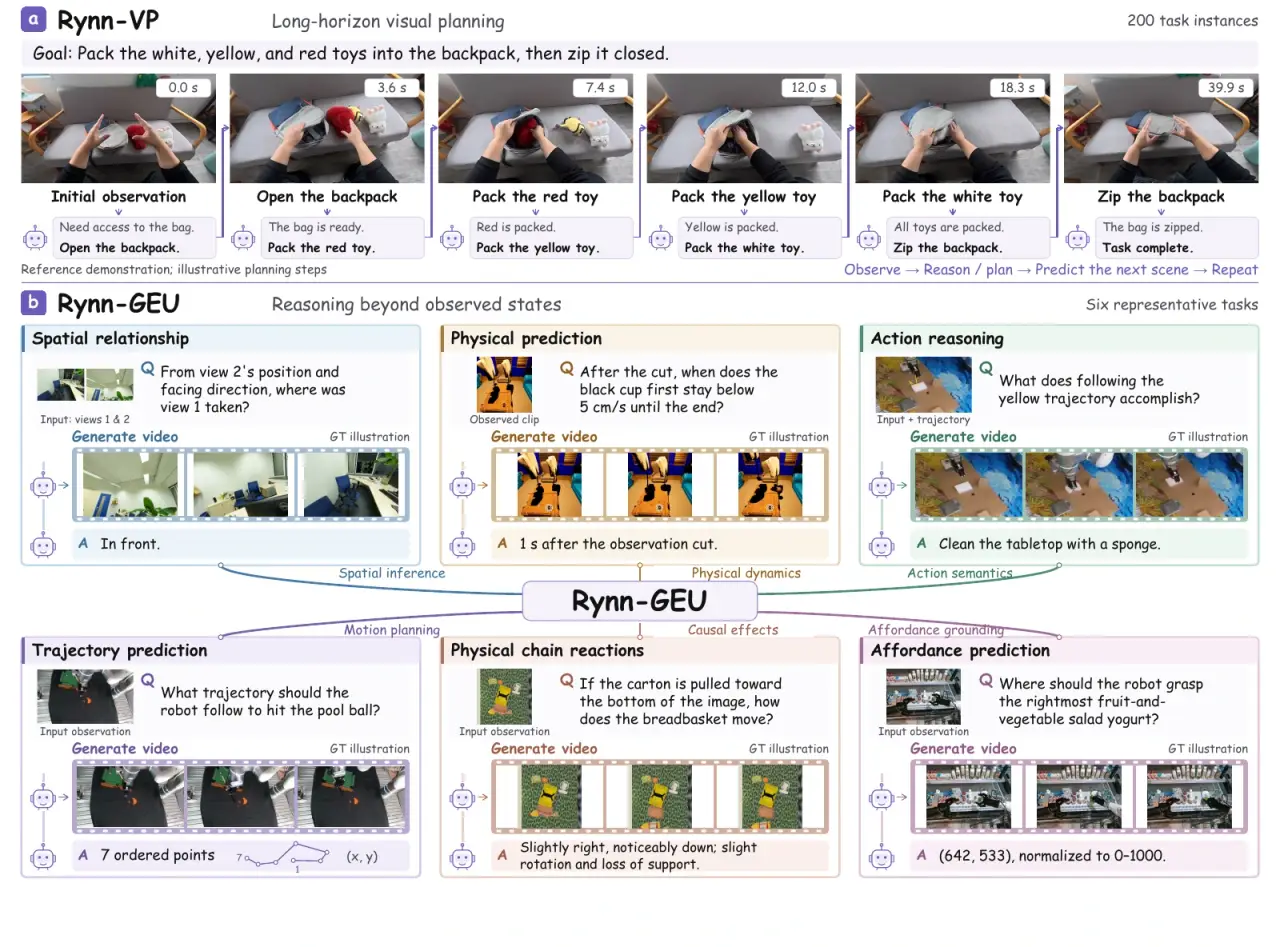
RynnUnify’s researchers have published a concrete test bed for a difficult question: can a model reason about what happens beyond the state it can currently see? The new RynnUnify-GEU-Bench repository contains what its authors describe as 2,000 multi-turn samples, with source images and stored rollout videos spanning ten embodied-understanding subsets.
Hugging Face records the repository’s creation at 09:15 UTC on October 29. The underlying RynnUnify paper was submitted to arXiv on October 23. Today’s news is access to this evaluation package, not a fresh launch date for the model family or a newly established performance record.
Ask, observe a rollout, then answer
The English dataset card lays out three stages. A model first receives visual input and a question, then emits a world-modeling description and duration. A subsequent user turn supplies the stored rollout video referenced by the record. The model then produces its reasoning and answer. The packaged video is an input to that protocol; its presence should not be mistaken for proof that the evaluated model generated it during the run.
The ten subsets cover position, direction, distance, size, physics, mess, affordance, area, action reasoning and trajectory. The authors group them into spatial consolidation, action rehearsal and dynamic rollout. That gives researchers a shared package for investigating where extra visual evidence helps, rather than relying only on a single final-answer score.
The card includes relative media paths, a JSONL record format and example local evaluation commands. Its dependency example uses Transformers 4.57 or newer alongside video-processing libraries; the illustrated Qwen runner uses eight GPUs. That example is an execution route, not a universal minimum hardware requirement. GPT-based scoring is also described for some question types, while an inference-only option skips that scoring step.
Research access, with research limits
The package is released for non-commercial research and evaluation, and its media remain subject to their upstream corpora’s terms. It should not be described as an unrestricted commercial dataset.
RynnUnify’s paper separately reports results for its unified embodied model, agentic extension and robot-control extension. Those remain the authors’ experimental findings. Publishing this package makes part of the evaluation workflow more inspectable; it does not independently reproduce the paper’s scores or demonstrate reliable robot deployment. AITrending reviewed the English dataset card, paper abstract and project page, but has not run the benchmark.