Laminar pitches flow-1 as a cheaper detective for agent failures
An October 19 Launch HN discussion brings attention to Laminar's trace-analysis model and its claim of GPT-6-sol-level detection at 23 times lower cost on a company benchmark.
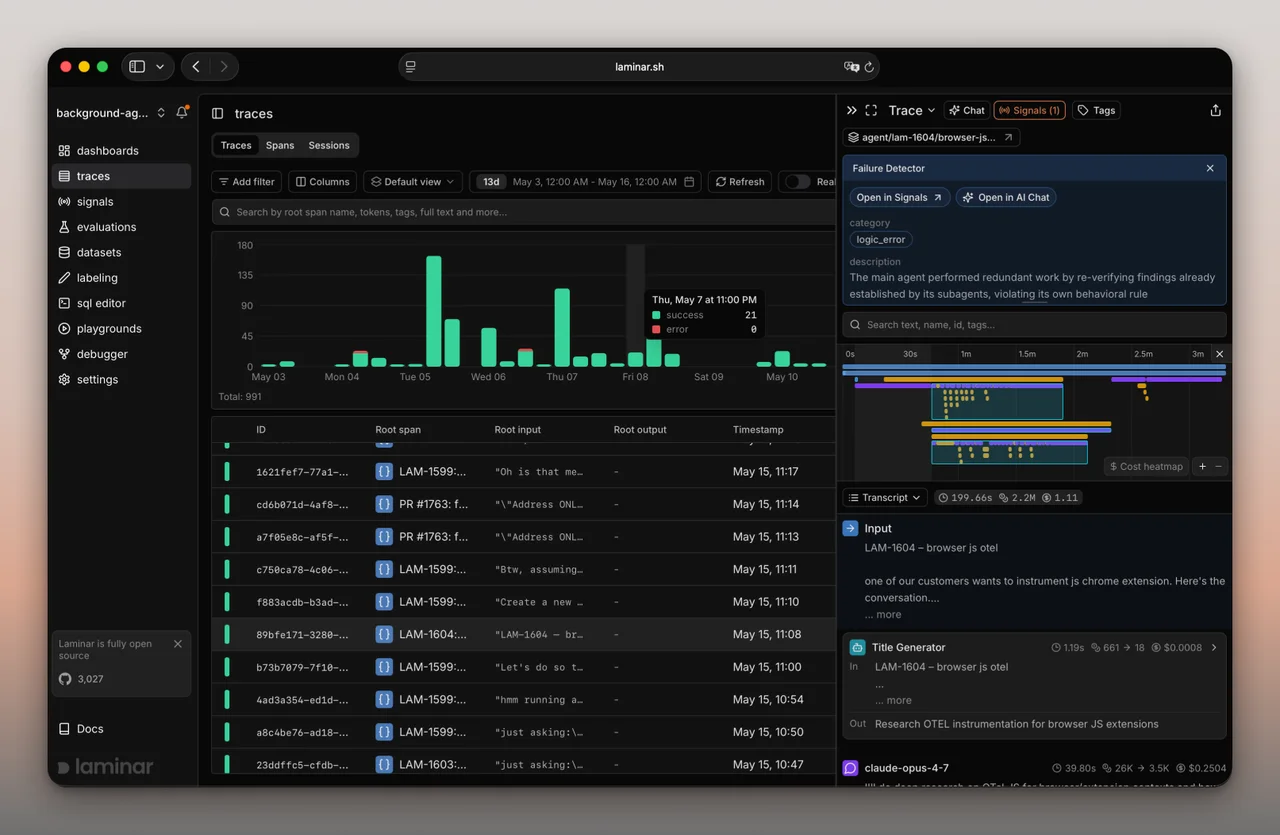
An agent can finish every tool call and still deliver the wrong result. Laminar is pitching flow-1 as a lower-cost investigator for those failures. The founders introduced the model and its Signals workflow in an October 19 Launch HN discussion, giving a fresh community entry point to technology first announced on October 2. This is a renewed introduction, not a newly released checkpoint.
Signals treats an agent trace like a code repository: each span becomes a file, and the investigator starts with a compressed overview and a user’s instruction. It can search spans, read relevant evidence and return structured JSON following a custom schema. That makes the workflow useful for questions such as whether an agent’s completion report matches its tests, or whether a contract edit matches the agreed terms.
The cost claim belongs to Laminar’s benchmark
Laminar reports a detection F1 of 0.835 for flow-1 versus 0.816 for GPT-6-sol on its own benchmark of 523 difficult traces spanning coding, legal work, support and other tasks. Its cost comparison uses complete Signals runs on traces below 100,000 total LLM tokens, and reports roughly 23 times as many traces per dollar for flow-1. Those are company measurements under specified conditions, not an independently reproduced result or a general claim about model quality.
The October 15 demonstration uses publicly released benchmark traces and links findings to particular spans. The earlier announcement also shows a contract-review example where flow-1 missed required AI-governance provisions that both comparison GPT-6 models caught. Cheaper investigation still leaves false negatives.
Open platform, separate model access
Developers send traces through Laminar’s SDK, define a Signal in plain English and inspect the resulting events. The platform supports a managed service and Apache-2.0 self-hosting through Docker Compose; SDK setup uses a project API key. Operators configuring self-hosted AI workers also need a model provider and credentials. The open platform repository should not be confused with a public release of flow-1’s model weights.
Related reading
Schemagate 1.9 stops MCP clients from choosing their own database roles
Promptise Foundry gives Python agents their own npm-style project runner