Looking Ahead releases Wan video weights trained to look beyond the next chunk
Tencent ARC and university researchers release code, 1.3B and 5B checkpoints, and baselines for Future Chunk Prediction, reporting better video physics without adding inference branches.
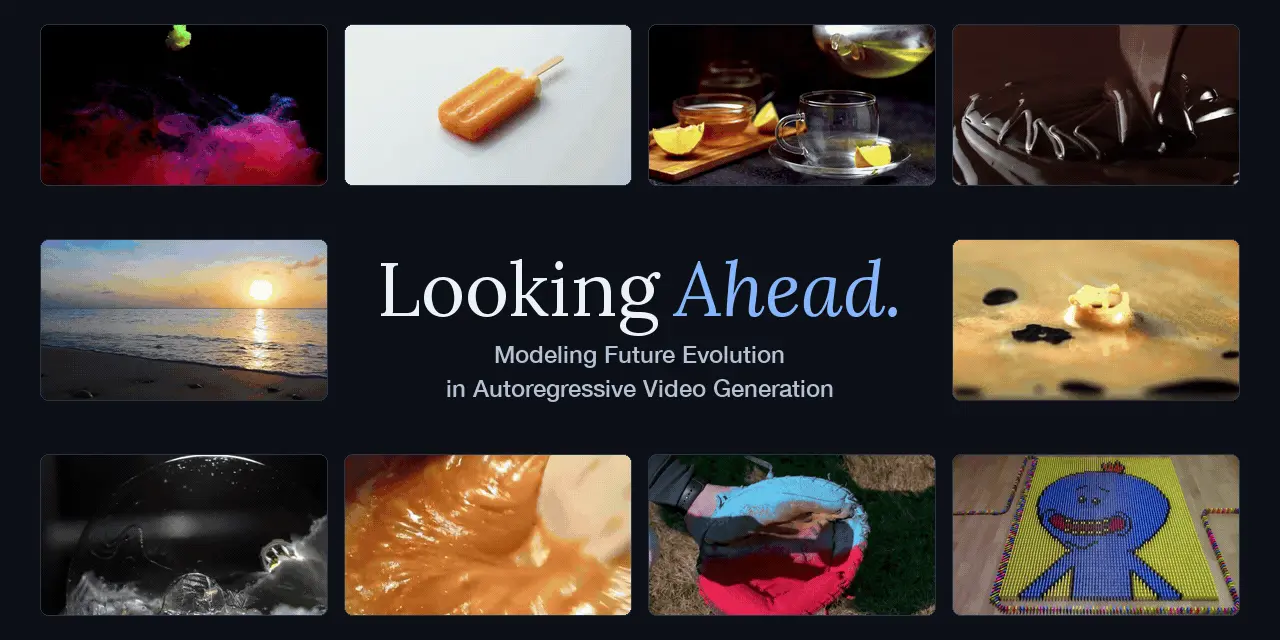
Looking Ahead gives video-model builders a new training recipe and downloadable Wan checkpoints aimed at a familiar failure: a clip can look smooth while its physical events stop making sense. Researchers from Nanjing University, Tencent ARC Lab and Zhejiang University released code, weights and demo data on October 21. Their paper, submitted to arXiv the same day, introduces Future Chunk Prediction, or FCP.
The release includes 1.3B and 5B configurations with both FCP and teacher-forcing baseline weights. That makes the work more than a collection of selected video demos: users can inspect the training implementation and compare the proposed method with the accompanying baseline. The reported improvements remain author measurements, not AITrending reproductions.
Train farther ahead, then remove the extra branches
The authors argue that ordinary teacher forcing lets an autoregressive video model exploit how similar neighboring chunks look. Matching the immediate continuation does not necessarily require learning how an event unfolds.
FCP adds auxiliary predictors that use the current chunk’s intermediate features to predict more distant chunks without seeing the intervening visual context. Its parallel branches do not exchange hidden states. Supervision comes directly from training videos, without an additional pretrained visual encoder.
According to the project, the FCP-specific modules are removed at inference, retaining the baseline’s autoregressive rollout. This is a training change, not an extra future-prediction service that must run beside every generated video. It also does not establish that the model reliably understands arbitrary real-world physics.
What the controlled comparison reports
On Wan2.2-TI2V-5B with matched training data and experimental settings, the project page reports these Physics-IQ results:
| Conditioning | Teacher forcing | With FCP |
|---|---|---|
| Image-to-video | 30.4 | 33.8 |
| Video-to-video | 40.6 | 44.4 |
Those are gains of 3.4 and 3.8 score points, or approximately 11.2% and 9.4% relative to the respective baselines. They are benchmark scores, not the percentage of all generated videos that obey physics. The page also reports gains on WorldModelBench, PAI-Bench-G and PhyGround, and labels its evaluation as means over seeds 42 through 45 for five-second videos at 24 FPS.
Weights are available; consumer-GPU support is unestablished
The README documents testing on Linux with an NVIDIA H200, Python 3.12.3 and PyTorch 2.10.0 with CUDA 12.8. Other environments have not been tested. The supplied inference examples use one GPU, but the documentation does not establish a minimum VRAM requirement or an 8GB desktop workflow.
Setup uses uv sync --python 3.12, plus FFmpeg. Users must download the matching upstream Wan components as well as the released checkpoint: Wan2.1-T2V-1.3B for the smaller configuration, or Wan2.2-TI2V-5B for the larger one. The model card’s command downloads all four final weight files, approximately 63.2 GiB in total; that is a download total, not a GPU-memory requirement.
Inference must pair each configuration with its matching model_ema.pt and --use_ema. The examples cover an image-conditioned sailboat clip and continuation of a milk-pouring video. For researchers studying temporal consistency, the immediate attraction is the released recipe, weights and baselines. The broader world-model interpretation remains a research direction rather than a demonstrated general capability.
Related reading

InkDoc puts the original PDF beside AI-ready Markdown
MAGAR-Bench opens 1,000 3D assembly challenges for multimodal agents