MiniMax reveals Space Bunny as M3.1 Flash at $0.60 per million output tokens
MiniMax launches its agent-focused Flash model at $0.15 input and $0.60 output per million tokens, identifies the anonymous preview, and says weights will follow later.
Space Bunny has a name: MiniMax says the anonymous preview was an early version of M3.1 Flash, its newly launched model for agent workflows, coding and computer use. The October 19 announcement lists immediate access through the MiniMax API, M Plan and MiniMax Code.
The clearest practical hook is the API price. Both the launch announcement and MiniMax’s live English pricing documentation list these USD rates:
| Token type | Price per million tokens |
|---|---|
| Input | $0.15 |
| Output | $0.60 |
| Cached input | $0.015 |
These are usage rates, not a fixed cost for finishing a software task. Agent runs can consume multiple turns, tool calls and different amounts of reasoning. The pricing guide also lists separate charges for server tools, so token prices alone do not describe every possible application bill. API access uses the provider’s standard API keys and account balance; M Plan is a separate access route.
MiniMax’s performance pitch
MiniMax says M3.1 Flash makes online inference nearly three times faster and reduces overall agent-task usage cost by 70% against its predecessor. Those are the company’s comparative claims, not a universal discount on every workload or an AITrending measurement.
The company reports 73.7% on DeepSWE v1.1 for software engineering, 61.7 points on OSWorld V2 for computer operation, 29.6 on Agents’ Last Exam, and 82% on CyberGym. It also claims output speeds above 200 tokens per second in some use and median speeds above 170 tokens per second. These results describe the provider’s evaluations and serving observations; they do not guarantee equivalent performance for a reader’s agent setup.
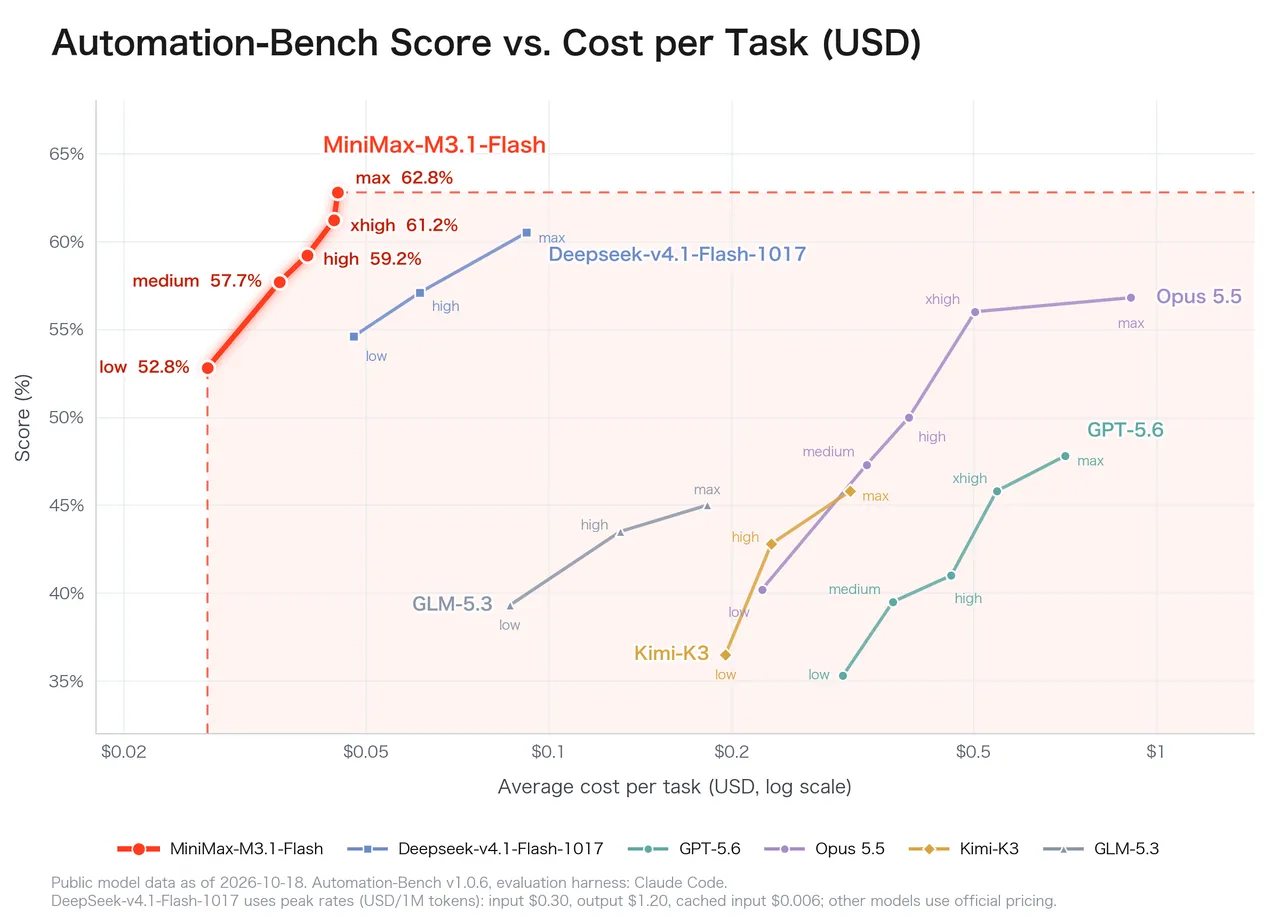
The announcement’s Automation-Bench cost chart compares models across reasoning settings. Its footer identifies Automation-Bench v1.0.6, a Claude Code evaluation harness and public model data as of October 18. That context matters when reading the plotted scores: the chart is MiniMax’s comparison, rather than an independently reproduced ranking.
Hosted now, weights later
The launch gives developers a named model and published API rates to evaluate in existing agent applications. It does not provide a downloadable checkpoint today: MiniMax explicitly says model weights will be released later, without committing to a date in this announcement.
The company also says a Pro model will arrive later. That future product is separate from the Flash access announced today. AITrending verified the English announcement and matching listed prices, but has not run the model or reproduced its benchmark and latency claims.
Related reading
OmO 5.1.38 lets goals keep running while the agent makes progress
Shunt tackles empty tool inputs when Claude Code runs another provider's model