Stop flattening your database: NVIDIA pitches Kumo Relational without task-specific training
The pretrained model uses historical labeled examples and relationships between tables to predict churn, demand or other outcomes. NVIDIA says it beats supervised baselines on its evaluation.
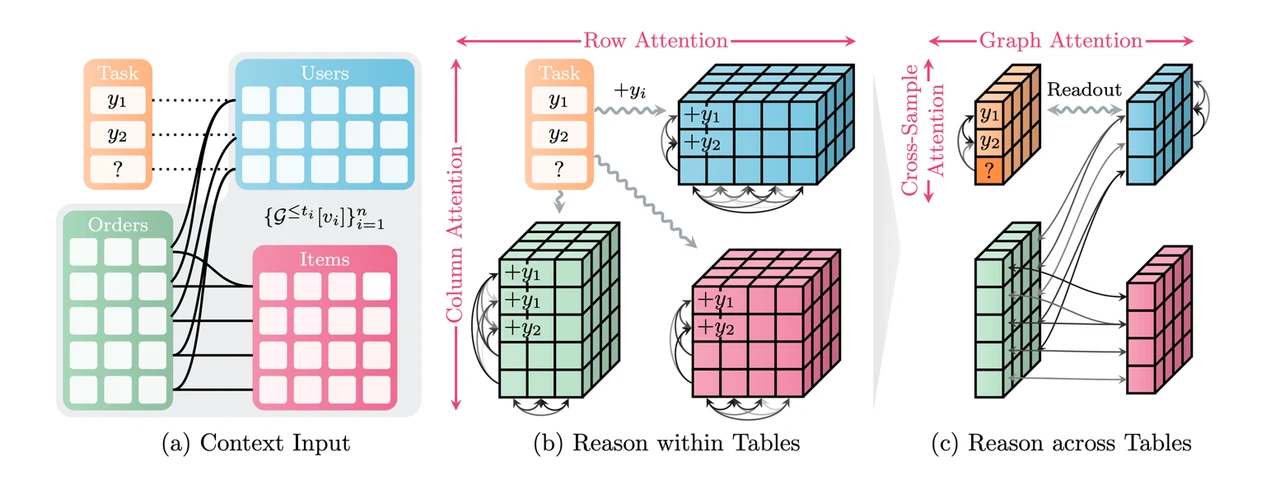
NVIDIA wants a prediction to become a database query instead of a new model-training project. Its October 21 Kumo Relational announcement describes a pretrained foundation model that predicts outcomes across linked tables, avoiding the manual flattening of customer, order and product records into one feature table.
The no-training claim has a specific meaning: no task-specific weight training is required for its in-context prediction route. The model still uses historical labeled examples, up to 10,000 in the reported evaluations, and GPU inference. It does not predict churn or demand from an empty database.
The relationships stay in the input
Kumo Relational reads table values and follows primary-key and foreign-key relationships, then relates examples with known outcomes to the entity being predicted. For time-dependent tasks, NVIDIA describes constructing context from records available before an anchor time and labels from subsequent events. That separation is intended to prevent future information leaking into the prediction input.
The Predictive Query Language interface can express questions such as how many orders each user will place over the next 30 days. A separate client gathers context and related tables before sending a request to a deployed NIM service. Local library examples expose those inputs directly. This is structured-data classification and regression, not a conversational model inventing a forecast in prose.
Strong results remain a developer comparison
NVIDIA reports evaluating 41 tasks across 15 relational databases and outperforming supervised relational models and engineered tabular pipelines. It also describes a custom graph engine handling databases with more than 500 billion rows. That engine-scale claim is not a claim that every row enters one model context or fits on one GPU. AITrending has not reproduced either the evaluation or the scale figure.
The company identifies limits: task-specific supervised models may retain an advantage with very large training sets, and useful signals must be reachable within a bounded number of relational hops. Fine-tuning remains an option. A database with weak relationships or an unsuitable context sample is not guaranteed to benefit.
Code and weights have separate licenses
The library installs as structured-data-models, requires Python 3.11 and PyTorch 2.7 or later, and downloads weights on first use. NVIDIA recommends additional GPU dataframe dependencies for CUDA workloads. Its authored library code uses Apache 2.0; the Kumo Relational weights use OpenMDW 1.1.
The model card describes it as based on KumoRFM-2. This week’s distribution announcement builds on earlier research, while the previously covered Kumo Tabular targets flat-table prediction. The new hook is preserving relationships across tables, rather than relabeling that September release as new.
Related reading
Liquid AI's LFM3 brings eyes, ears and tool calls to a compact local-model family
STROT deletes its LLM fallback after a hate-speech test failed to justify the cost