NVIDIA makes recorded audio a prompt-controlled workflow
Nemotron 3.5 Transcribe combines transcription, translation, speaker attribution and audio questions, with open weights and substantial serving requirements.
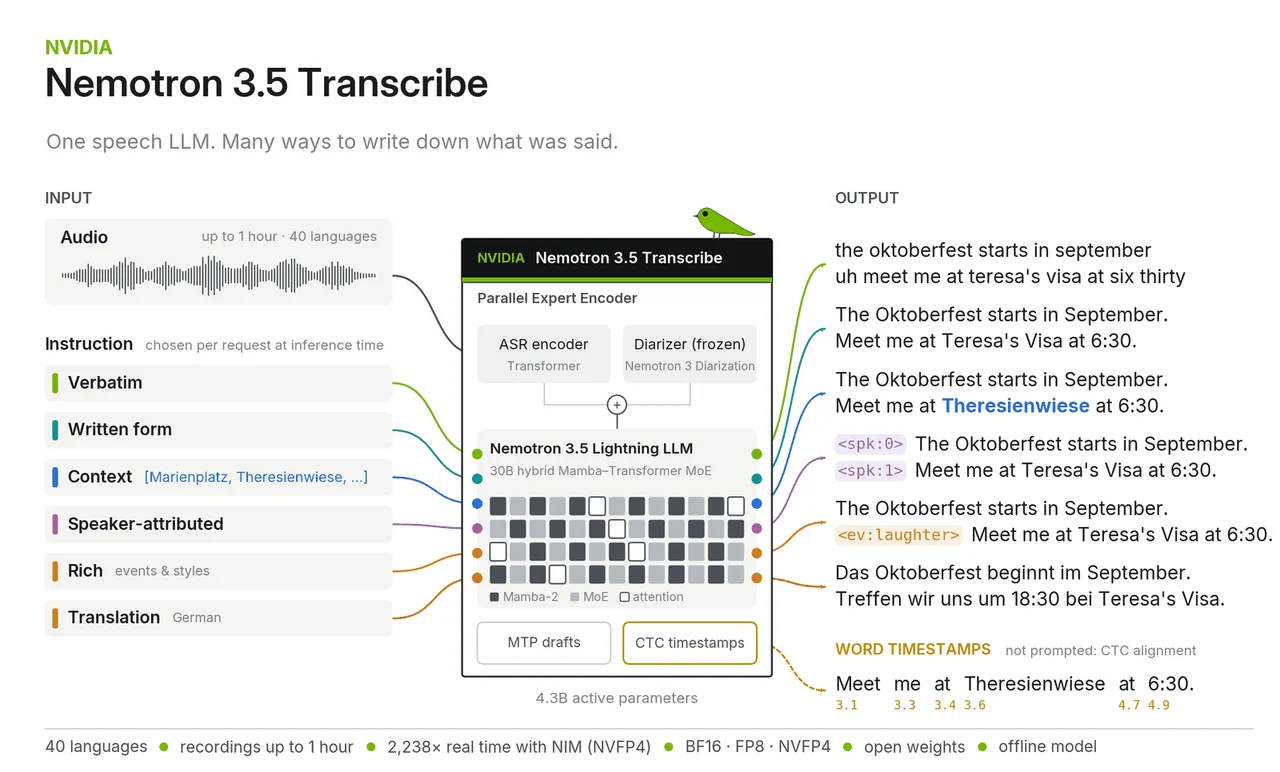
Tell the model what to do with a recording, rather than assembling a different pipeline for each audio task. NVIDIA’s newly released Nemotron 3.5 Transcribe offers transcription, translation, speaker attribution and audio question answering through natural-language prompts.
For teams processing interviews, meetings or recorded support calls, the attraction is a common model interface with instructions controlling the output. NVIDIA describes choices such as verbatim versus written-format transcription and domain-term hints. These are the vendor’s documented capabilities; AITrending has not independently tested their accuracy.
Language coverage depends on the task
NVIDIA lists transcription in 40 languages and translation to and from English for 31 languages. Its announcement describes speaker attribution in 13 languages, with support for up to eight speakers, while audio question answering is English-only. Speaker labels within a recording do not establish the speakers’ real-world identities.
The model card supports recordings up to one hour. This is an offline, recorded-audio model, not a real-time streaming service; internal audio chunking should not be mistaken for live transcription support.
Open weights do not mean a small deployment
The release includes BF16, FP8 and NVFP4 variants under OpenMDW-1.1. Although its mixture-of-experts design activates only part of the network per token, the model card lists 34 billion total parameters and 4.3 billion active parameters including the audio encoder.
The reference quickstart uses an H100 with 80 GB of memory, vLLM 0.32.0 or later and the latest NeMo Speech code. That is a substantial serving setup, even when the active-parameter count sounds comparatively small.
NVIDIA’s headline throughput figures and the speed claim shown in its overview image refer to optimized NIM serving. The announcement says those optimizations are not yet in the open-source integration and anticipates slower vLLM performance. Readers evaluating the released weights should keep those deployment paths separate.
The English announcement and model card both place the release on October 28. Its concrete news value is prompt-controlled handling of several recorded-audio tasks in one checkpoint, with language and infrastructure limits that matter when choosing a deployment.