Where did your Claude Code budget go? OMNI adds project-by-project spending
OMNI v0.7.12 adds model, project and session spending breakdowns from Claude Code transcripts, alongside fixes for database output, failing tests and secret masking.
OMNI’s latest release gives Claude Code users a way to ask which project, model or session consumed their token budget. Version 0.7.12, published October 22 at 04:05 UTC, adds API list-price spending breakdowns to omni stats --view bill. The useful distinction is attribution: a compression percentage alone does not say where the money went.
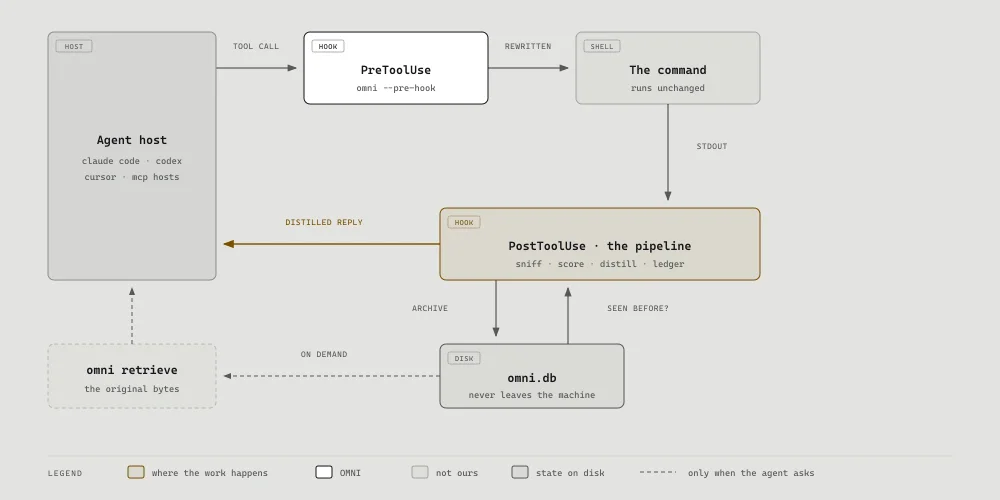
OMNI is a local Rust tool that hooks into existing coding agents, reduces selected tool-output noise and replaces repeated content with retrieval handles. It is not a model provider or a replacement coding harness. The new spending breakdown reads the host’s records rather than treating OMNI’s own compression counters as a bill.
A transcript report, with an invoice caveat
The pinned statistics reference says the bill view reads Claude Code transcripts. It groups estimated spending by model and project by default, with a session view available for finding expensive runs:
omni stats --view bill
omni stats --view bill --since week --limit 0
omni stats --view bill --by session
The report counts repeated usage records for a request once. Subagent requests contribute to the spending tables, while their separate contexts stay out of the main session’s token and context tables. Unknown models appear as unpriced, with the total labelled a lower bound, rather than silently costing zero.
These are API list-price estimates, not reconciled provider invoices. Subscription plans and negotiated rates can differ. The reviewed implementation uses a versioned price table labelled October 6; this is not evidence of a live pricing feed. The documentation also describes cache-write TTL and fast-mode adjustments. No dollar-saving result is established by adding this accounting view.
Output filters get practical repairs
The same release says sqlite3, psql and mysql rows now reach the agent as printed, and successful queries are no longer labelled errors. Failing Bun tests retain file-and-line information plus expected and received lines. Those are useful boundaries for a tool whose job involves reducing output: removing the clue an agent needs would undermine the workflow.
Secret masking also changes. The release says tokens inside YAML or other structured output are hidden in place, while comparisons such as token === "py" stop being treated as credentials. These are maintainer-described fixes, not an independently tested guarantee that every secret will be caught or every output preserved.
Installation and host support are separate questions
The README documents Homebrew on macOS and Linux, followed by local setup and diagnostics:
brew install fajarhide/tap/omni
omni init
omni doctor
It also provides Windows PowerShell and WSL installation routes. Claude Code marketplace and agent-skill routes install instructions; the OMNI binary still needs to be installed separately. OMNI is Apache-2.0 licensed. Model access and any provider charges remain separate from this local utility.
The project’s compatibility table lists full output rewriting for hosts including Claude Code, Codex CLI and Pi. Codex CLI users must approve the installed hooks under “Hooks need review”. Cursor and Windsurf rely on the omni_run handoff; MCP-only hosts such as OpenCode do not get automatic rewriting of their built-in output. Broader host compatibility does not make the new bill view a spending dashboard for every host.
Archived output is local, but retrieval is not indefinite: the documented archive window is 30 days. AITrending reviewed the versioned sources and accounting code, without installing OMNI or reproducing its compression and cost claims.