Pika Flex gets a four-step ComfyUI video workflow with sound
WAS's community patches now include a worked example for first-frame and reference-image video, combining Pika adapters with MiniMax H3 trajectory distillation.

Local video creators have another route to Pika Flex motion in four sampling steps, with audio included. Hugging Face user WAS has added a worked ComfyUI example to Pika H3 Flex PTD, a community set of model patches combining Pika’s adapters with MiniMax H3’s four-step Parametric Trajectory Distillation files.
The weights themselves were uploaded on October 29. The new development is the November 1 addition of an example workflow, its input pictures and rendered clips. The refreshed card shows a lighthouse first-frame example and a portrait-reference example. Those are the author’s demonstrations, not AITrending reproductions or proof of a particular speed on a consumer GPU.
One patch for each video route
The card lists separate files for first-frame-to-video (fl2va) and reference-to-video (Ref2VA), around 4.79 GB and 4.82 GB respectively. Each stores a Pika H3 Flex adapter at strength 0.5 alongside the corresponding four-step PTD adapters. The card credits EPFL VITA’s PTD weights for fl2va and taobao-content-ai’s PTD LoRAs for Ref2VA.
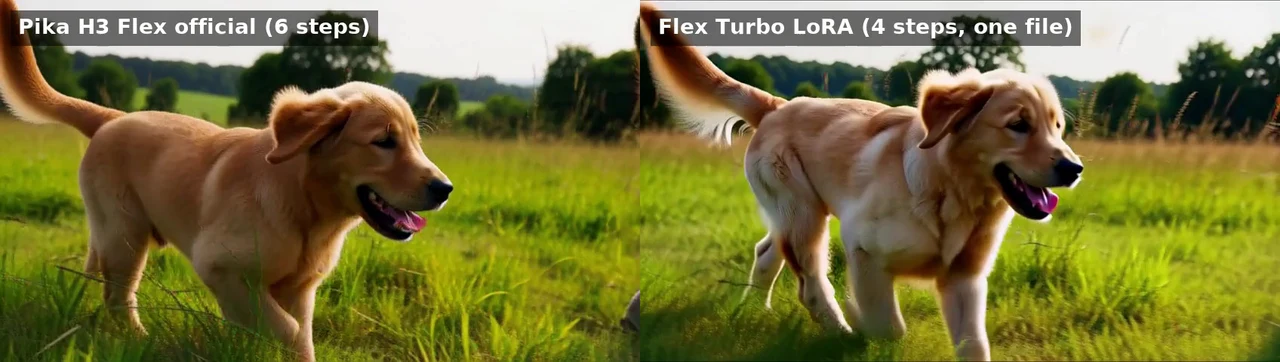
This is a different route from akhaliq’s previously covered Pika Flex and LightX2V Turbo LoRA fusion. WAS’s files are model patches loaded through the H3 PTD Patch node in WAS Node Suite. The card says no separate Pika node or Pika LoRA is needed because the adapter is already inside each file. Other LoRAs can still be applied on top.
What the example requires
Users put a patch in ComfyUI/models/ptd or ComfyUI/models/model_patches, load its matching MiniMax H3 transformer, and connect both through the patch node. The documented settings use four steps, CFG 1 and Euler sampling with the node’s sigmas; a KSampler route uses the simple scheduler.
The example describes 1344-by-768 video with 124 frames, approximately five seconds at 24 fps. It also requires the base transformers, a Qwen3-VL text encoder and separate video and audio VAEs. Downloading the patch alone does not provide a complete generation setup.
The model card identifies these as modified files under the MiniMax H3 Community License Agreement, not an unrestricted software release. The practical attraction is a documented four-step workflow with inputs to inspect and reuse. No matched timing benchmark in this card establishes an end-to-end speedup or equivalence to hosted Pika services.
Related reading
Pika Flex in four steps: a community LoRA claims faster local video