Pika Flex in four steps: a community LoRA claims faster local video
akhaliq's fused adapter combines Pika H3 Flex with LightX2V Turbo; its author reports 66.0-second completion versus 109.3 seconds for a six-step reference on one A100 setup.
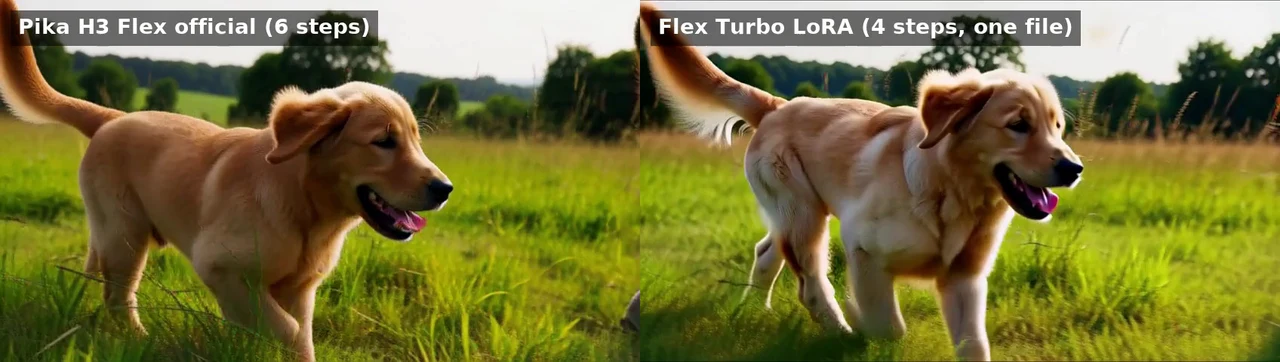
Pika H3 Flex already has a community shortcut for local creators: one LoRA that combines its motion adapter with LightX2V’s MiniMax-H3 Turbo and targets four-step video generation with synchronized audio. The October 29 release from Hugging Face user akhaliq includes downloadable weights, a reproduction script and an author-published comparison against a six-step Pika reference.
The practical pitch is less adapter juggling. Instead of loading Flex and Turbo separately, users can select a fused file for the appropriate MiniMax-H3 transformer. Four-step files target speed, eight-step files target additional detail, and smaller rank-32 variants reduce the adapter download. These are community options, not new Pika API tiers.
What the speed claim actually measures
The author reports 66.0 seconds from conditioning to MP4 for the four-step LoRA, versus 109.3 seconds for the six-step Pika adapter. The card describes an A100 80GB, ComfyUI 0.43, an int8 H3 base, 848-by-480 output, 121 frames with stereo audio, CFG 1 and seed 42. That is the basis for its claimed 1.66-times end-to-end speedup.
Sampling alone reportedly fell from 75.2 to 50.1 seconds. The card says the per-step cost stayed roughly the same: the gain comes from fewer evaluations. AITrending has not reproduced these measurements, and one prompt and configuration do not establish equal quality across scenes, reference inputs or hardware. The author’s side-by-side generated clips let readers inspect one example, rather than proving general visual equivalence.
Repository history separates the dates clearly: creation was at 18:45 UTC, the first fused FL2VA weight upload at 18:57:53, and the measured benchmark table at 21:45:21 on October 29. The news is the uploaded adapter and comparison, not a collection timestamp or a claim of virality.
A local workflow, with local requirements
The card recommends putting the matching file in ComfyUI’s LoRA directory, loading it with LoraLoaderModelOnly at strength 1.0, and matching four or eight sampling steps to the file. It specifies CFG 1.0 and documents additional scheduler and flow-shift settings. An existing compatible MiniMax-H3 installation is still required; the adapter is not a complete lightweight video model.
The author also warns against stacking strong extra style or motion LoRAs on the four-step version. Compatibility across H3 builds is the author’s claim, not a platform-by-platform validation by AITrending.
Pika’s official documentation draws another useful boundary: local inference produces native 480p or 768p video with mixed stereo audio. Its higher-resolution finishing, separate audio stems and accelerated serving are hosted extensions. Downloading this community fusion does not add those services. Both the official card and community release identify MiniMax H3 Community License terms, so open weights should not be read as an unrestricted software license.