This 44-skill agent kit wants every screen to earn its place before AI builds it
Pawel Huryn's community skill collection adds a job-to-screen map, populated prototypes and a newcomer walkthrough to its documented design workflow.
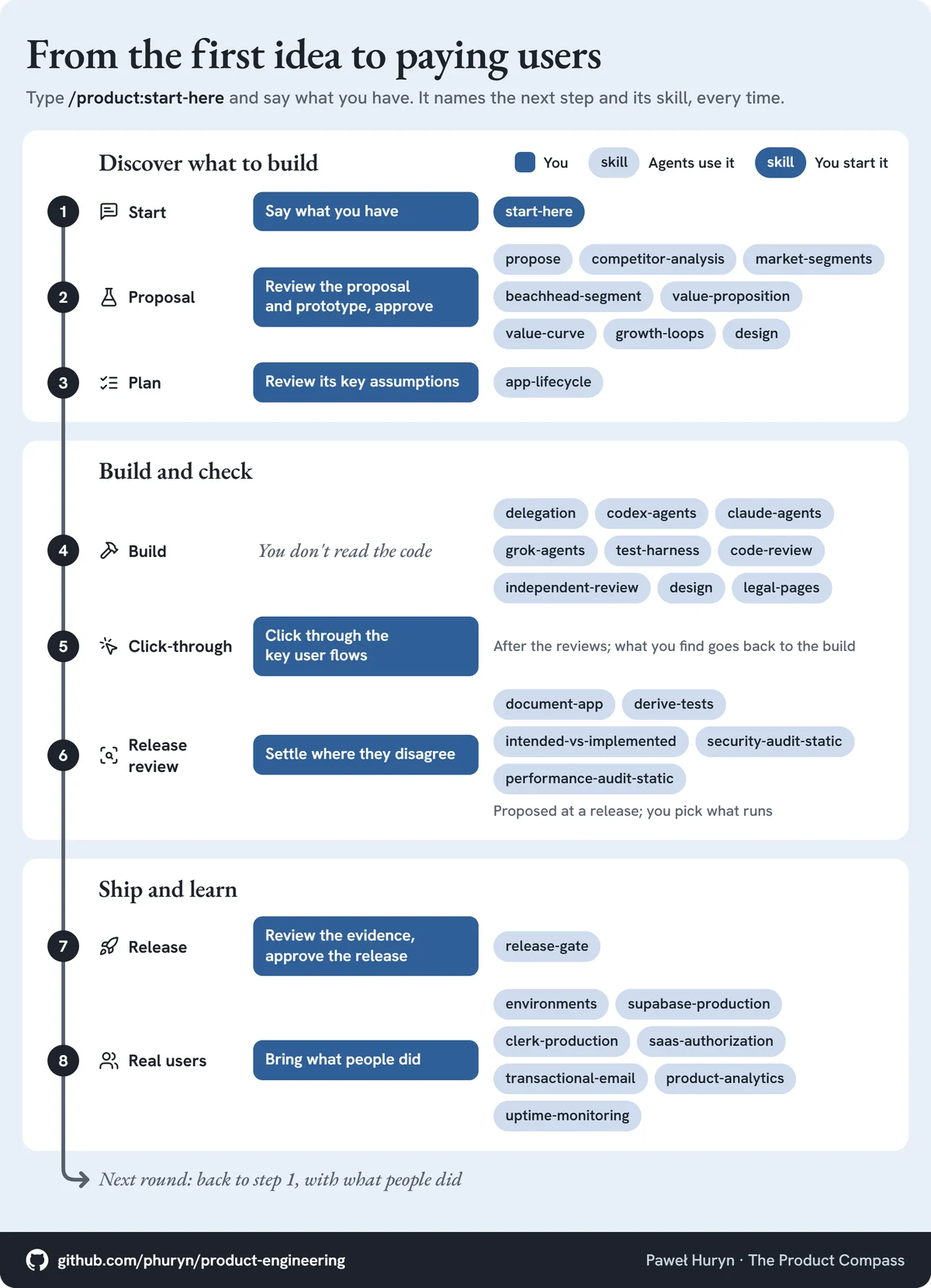
Before a coding agent draws another dashboard, Product Engineering wants it to explain what a person came to do there. Version 1.2.0 of Pawel Huryn’s community skill collection adds an explicit map from user job to screen, the question that screen answers and its primary action. Its rule is blunt: a screen with no job gets cut.
The November 3 release applies the design method to builders as well as coordinating agents. It also calls for example data in every screen and tab, so a prototype can be tried without encountering empty placeholders everywhere. Product data rules should appear as understandable outcomes, rather than database terminology copied into the interface.
A stranger should be able to find the next step
The updated instructions require a newcomer walkthrough before the owner’s click-through. A person or fresh session, given the running app and the user’s job rather than the brief or code, should explain each screen’s purpose and what to press next. A rendered-screen review follows.
These are instructions for the host agent’s workflow, not a separate application enforcing a technical release lock. Their effectiveness depends on the agent and people following them. The release provides no controlled benchmark showing that the new method reduces defects or improves usability.
The broader lifecycle changes prioritize visible work against its cost: initial screens should include the landing page, displayed pricing and placeholder legal pages, with those made accurate before further feature phases. The release explicitly says sample prices must not reach a page strangers can open. It also moves monitoring proposals to after a production launch instead of treating a development preview as a live service.
Six packs for existing coding agents
The tagged repository documents 44 skills across six packs, covering product decisions, shipping, agent teamwork, agent setup, an application stack and writing. This is a community skill bundle for existing coding agents, not a new model or standalone development environment.
The README lists Claude Code, Codex, Cursor, Gemini CLI, OpenCode and GitHub Copilot among its intended hosts. It documents marketplace installation for Claude Code and Codex, and npx skills add phuryn/product-engineering or manual folder copying for other agents. The npx skills route requires Node.js 22.20 or later. Host support is documented by the author; AITrending has not installed or tested the bundle across those clients.
The collection is MIT-licensed and free to obtain. It does not supply model access or remove the costs and account requirements of whichever agent, provider or application services a user chooses. Some included wrappers execute existing CLIs when invoked; installing instructions is not the same as granting every operation permission or proving that an agent will follow them reliably.
Related reading
Gentle AI puts Pi workspace installs inside its terminal UI
Stop asking Claude to rewrite the audit: vault-posture adds an offline report