NVIDIA opens a free GPU window for protein design in your browser
RFD4-Proteina's dedicated Hugging Face Space is sponsored from October 21 to November 4; a shared ZeroGPU option remains afterward.
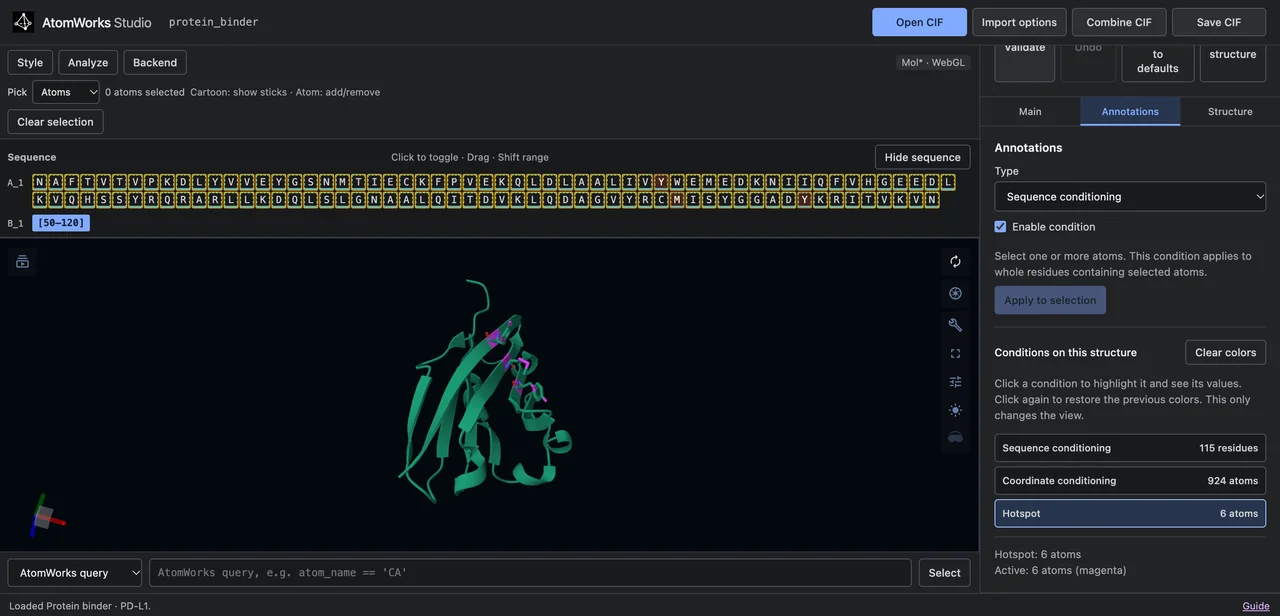
Researchers can try RFD4-Proteina on sponsored dedicated GPUs without installing a local protein-design stack. NVIDIA says its Hugging Face Space is free from October 21 through November 4, 2026, running on RTX PRO 6000 GPUs. The company’s new English walkthrough turns that access window into a concrete browser workflow: choose a target, mark the atoms a designed binder should engage, generate a candidate and save the annotated files.
RFD4-Proteina, developed by NVIDIA and the University of Washington’s Institute for Protein Design, generates protein sequences and all-atom structures together. Its current paired checkpoints are dated October 19 in the model card. The October 21 development is the sponsored access and workflow announcement, rather than evidence that the model first appeared today.
Start with an annotated target
Both the dedicated Space and the shared ZeroGPU Space use AtomWorks Studio to inspect and annotate molecular inputs. NVIDIA’s example starts with PD-L1, a supplied target with marked hotspots and a binder specification. After generation, users can inspect contacts and download the design, annotated target and complex as CIF files. Saving the seed and keeping the input makes comparisons with later runs more useful.
Changing the seed samples another candidate. Low, medium and high thinking settings alter the amount of refinement and compute per design; medium is the default. Reward-guided search is a separate workflow option using external evaluators, not another name for a successful laboratory experiment.
When the sponsored window closes on November 4, NVIDIA says the dedicated Space stops being free. The ZeroGPU Space remains free on shared capacity, subject to Hugging Face account quotas. The announcement does not promise unlimited capacity or a particular post-window dedicated price.
A generated binder still needs validation
The article’s illustrated PD-L1 binder is a computational sample. A plausible contact in a viewer does not confirm binding, developability or therapeutic usefulness; experimental characterization remains separate. NVIDIA says the hosted Spaces screen inputs and generated designs with SecureDNA. AITrending reviewed the published workflow and model documentation but did not run a generation or independently validate the screening system.
For local work, the documented native runtime needs Linux x86_64, Python 3.12 and a supported NVIDIA GPU with the appropriate CUDA environment. The model and weights use BSD 3-Clause, while optional third-party refolding assets retain separate terms. Diffusers support has been merged but requires installation from GitHub until its next release. The browser route is the immediate low-setup way to inspect the workflow before committing local compute.
Related reading
InkDoc puts the original PDF beside AI-ready Markdown
MAGAR-Bench opens 1,000 3D assembly challenges for multimodal agents