Spark-X2.6-4B is a local-agent model worth a look, with thinking you can dial down
The compact model appears in the current Hugging Face trending collection, with three thinking budgets and documented routes from MLX to llama.cpp.
Spark-X2.6-4B deserves a place on the shortlist for developers trying to run a small agent model locally. The October 27 Hugging Face trending collection surfaced the checkpoint with 748 likes and 6,191 downloads, while its English model card offers a practical hook: three thinking budgets, labeled none, low and high, for trading reasoning effort against latency and compute use.
This is renewed attention to an existing model, not a launch today. Hugging Face records the repository’s creation on October 19 and its latest modification on October 27. Those dates establish repository activity; they do not identify a new release or prove a rate of adoption. The counters are a dated snapshot, not unique users or evidence of viral growth.
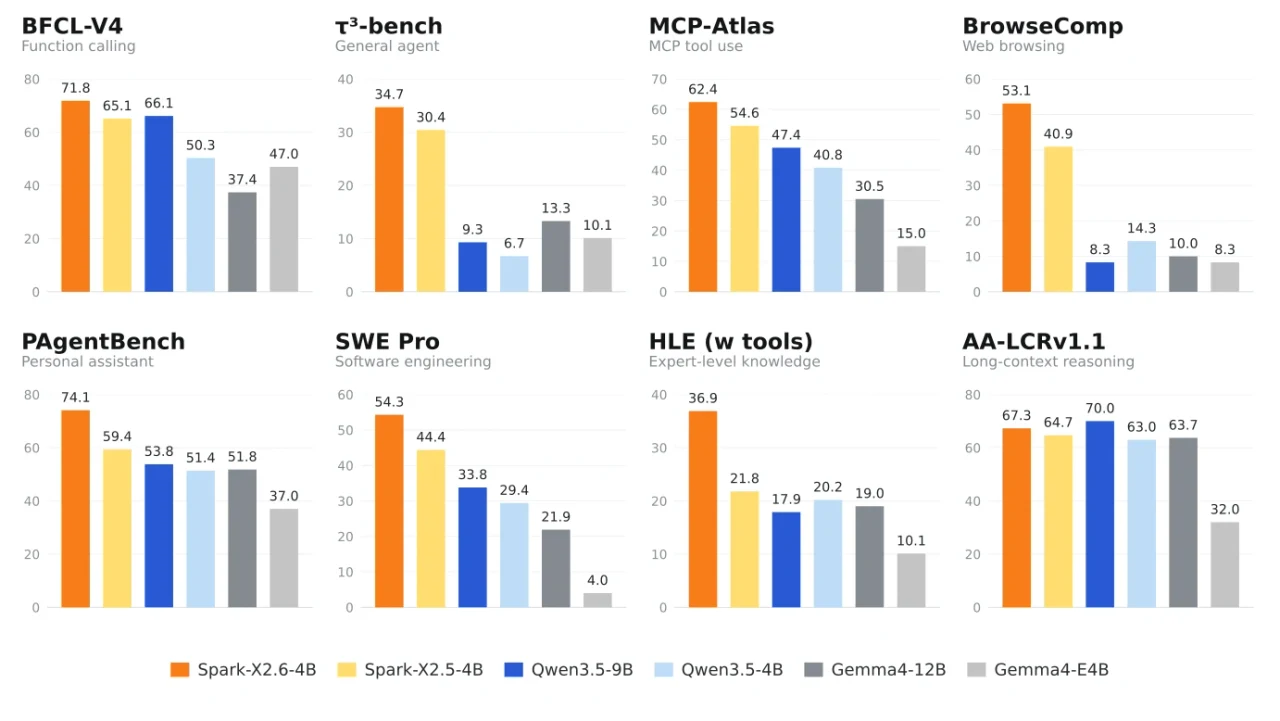
The authors say X2.6 keeps the same architecture as Spark-X2.5-4B, with improvements coming from post-training. Their published chart compares coding, agent and tool-use tasks against several compact and larger models. These are the team’s own results. They support reporting its competitive pitch, but do not establish that the checkpoint wins on every task or in every local configuration.
The deployment choices make the recommendation useful beyond a leaderboard. The card documents Transformers, SGLang and vLLM, plus an MLX implementation for Apple silicon, Linux CPU and Linux CUDA environments. It also specifies native llama.cpp support from build b10828, Ollama 0.34.1 or newer, and LM Studio 0.4.0 or newer. Users should follow the guide for the particular runtime instead of assuming every installation supports this architecture.
The model card lists Apache-2.0. Running the weights locally still requires compatible software, storage and sufficient memory; its very long-context server example explicitly warns about device-memory requirements. An application must supply the surrounding tools and permissions for an agent workflow. For a developer comparing small local models, controllable reasoning and concrete runtime options are the reason to try it, rather than a promise of unattended success.
Related reading
AndroidHarness brings installable agent plugins to your phone
Kortix makes pi the default agent harness and puts runaway automations on pause