Speculative Forcing reports 1.58x faster video by letting tokens stop early
KAIST AI and NAVER AI Lab researchers report matching LongLive's four-step video quality with about 1.7 denoising steps per token on one H100. Their implementation is still under internal review.
Stop polishing the tokens that are already close
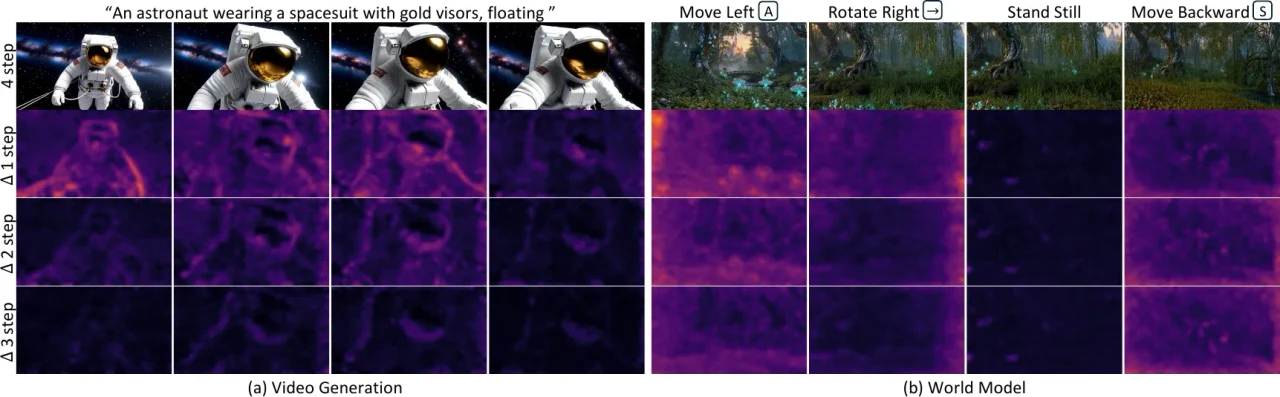
Speculative Forcing asks a practical question about streaming AI video: why make every token complete the same denoising schedule when some already resemble their final output? In a new preprint, researchers from KAIST AI and NAVER AI Lab report faster generation by accepting those tokens early and spending the remaining computation on the ones still changing.
The method treats intermediate clean estimates as drafts. A verifier predicts whether a token is close enough to its full-step result. Accepted tokens are frozen, while their cached keys and values remain available to the tokens that continue refining. The authors study both a training-free verifier and a learned verifier that reads the frozen generator’s intermediate features. The generator’s weights do not change.
What the reported speedup actually measures
On five-second LongLive videos, the authors report 41.7 frames per second versus 26.4 for four-step sampling, a 1.58x speedup on a single NVIDIA H100. The method averages 1.68 denoising steps per token. Their VBench total rises slightly from 83.08 to 83.21, which they present as preserving the baseline’s quality.
For 30-second LongLive videos, the reported throughput is 37.8 rather than 24.5 frames per second, with 1.72 steps per token. On Lingbot-World 2.0, where camera movement reveals new content, the reported gain is smaller: 24.5 rather than 18.1 frames per second, or 1.35x, with 2.55 steps per token.
These are the authors’ benchmark results for the stated generators and hardware. They do not establish a speedup for every video model, consumer GPU or production workload, and a similar aggregate quality score does not mean every generated frame is identical. The project’s tolerance setting trades speed against quality.
The paper and demos are public; the implementation is pending
The October 15 preprint and English project page include the method, result tables and generated demonstrations. The authors label all videos on the project page as generated. Their convergence illustration shows differences between intermediate predictions and four-step outputs, rather than independently measured real-world footage.
At review, the linked GitHub repository says the code is under internal review and will be released later. It does not yet provide a runnable implementation or installation recipe. This is a new research result to watch for streaming video and world generation, with practical reproduction still pending. AITrending has not reproduced the speed or quality measurements.
Related reading
Google opens SynthID Detector site for checking AI media watermarks
Cal AI founder's growth playbook relies on close-knit influencers and repeat posts
