SupraTTS packs an English voice into a 1M-parameter core
SupraLabs' downloadable speech preview reports roughly 85 times real-time CPU synthesis, with small automatic-scoring tests and an English-only scope.
A speech model aimed at ordinary CPUs
SupraLabs is pitching SupraTTS-1.0-Preview as an unusually small English text-to-speech system: its three-stage core has 1,031,754 parameters, according to the released configuration. The downloadable preview produces 24 kHz mono audio and ships a Python runtime, weights, sample recordings and benchmark scripts on Hugging Face.
The author reports a median real-time factor of 0.0118 on a Ryzen 5 3500X in a 24-sentence test, equivalent to roughly 85 seconds of generated speech per second of computation. That is a specific author-run CPU measurement, not a guarantee for every machine or sentence. The card compares it with the earlier SupraTTS-0.1-Beta on the same CPU and reports approximately 44 times faster synthesis.
The three stages predict phoneme durations, build a mel spectrogram and decode that representation into a waveform. A separate bundled English grapheme-to-phoneme front end uses dictionaries and a small fallback for unfamiliar words. The card describes runtime and weights as MIT-licensed, with Apache-2.0 dictionaries. It does not present this preview as a multilingual voice-cloning service.
The headline quality claim needs its test conditions
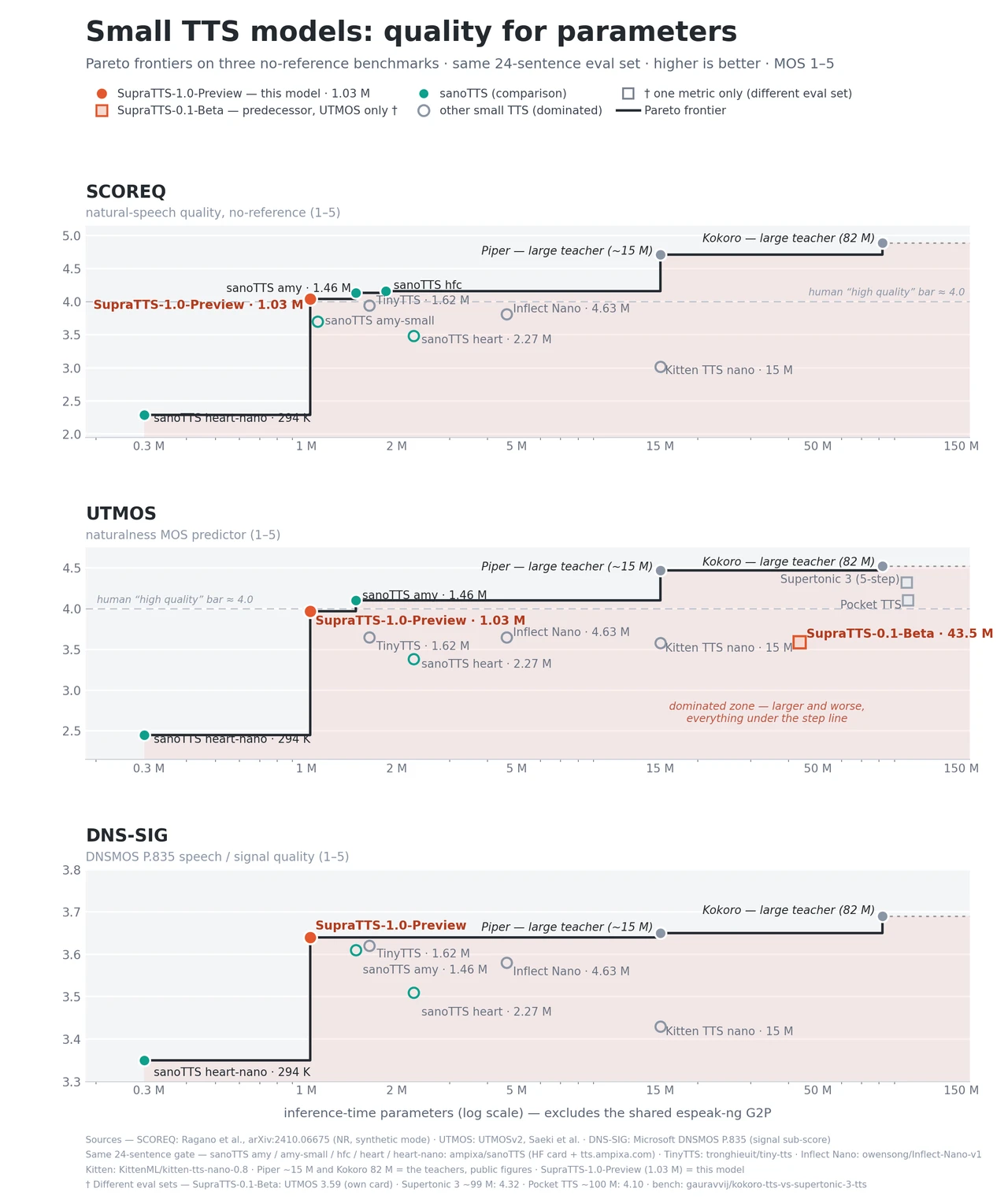
The model card calls the system “The new quality-per-parameter Pareto frontier for open TTS.” Its evidence is automatic scoring, including SCOREQ, UTMOS and DNSMOS, on a small 24-sentence evaluation. The table places the preview below the larger sanoTTS amy model on SCOREQ and UTMOS, while above it on DNSMOS-SIG. This supports a reported size-versus-score tradeoff within that comparison, not a universal listening-quality victory.
The card also says its predecessor’s quality results use different sentences and seeds, so those quality rows are directional rather than a controlled head-to-head result. The author-published chart marks some additional comparison rows as using different evaluation sets. These are predicted quality scores, not ratings from a new human listening panel. AITrending has not run the checkpoint or independently reproduced the speed or quality numbers.
Download, then synthesize locally
The documented route uses hf download SupraLabs/SupraTTS-1.0-Preview --local-dir supratts-1-0-preview, followed by installing the repository’s requirements. Those list NumPy, PyTorch 2.0 or newer, and SoundFile. The guide then loads MicroTTS from the downloaded directory, synthesizes a string and saves a WAV file. The author says inference needs no network access after setup.
The repository was created October 15 and includes an initial-release commit explicitly labelled private. An October 17 documentation edit brought it into this discovery pass; that edit should not be mistaken for a newly trained checkpoint or a known first-publication date. A larger version and additional languages remain roadmap items, not capabilities shipped in this English preview.
Related reading
Promptise Foundry gives Python agents their own npm-style project runner
MonoCode takes remote coding agents into systemd-free Linux containers