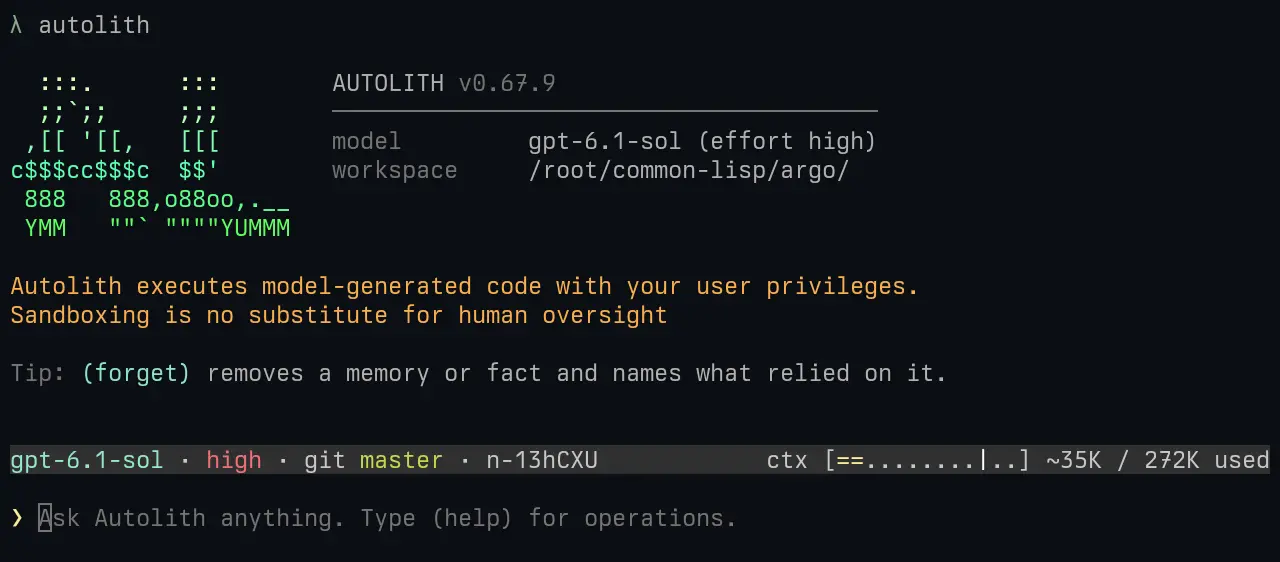
UNCUT's coding agent refuses to quietly cut your context
The tiny Go harness sends full history and tool output, fails explicitly on provider truncation, and now fixes quoted Windows commands.
UNCUT is pitching a small coding agent with a blunt contract: keep the context intact, or fail visibly. Its November 1 version 0.1.1 release adds a Windows command-quoting fix and a reproducible proof suite for the project’s claimed lossless transport.
The project describes a roughly 7 MB, MIT-licensed Go executable for shell pipelines, CI jobs, containers and local-model experiments. It is a standalone harness, not a Pi extension or a new language model. Four tools cover full-file reads and writes, exact replacement and shell commands; there is no terminal UI or plugin system.
Full history, explicit limits
According to the versioned README, UNCUT sends the entire conversation on each model call and does not silently truncate valid UTF-8 file contents or combined command output. Optional append-only JSONL sessions preserve history for later resumption. If a provider reports that it cut an answer at its output limit, UNCUT rejects the partial answer as an error.
Lossless does not mean unlimited context. The model can still reject a request that exceeds its context window, and the harness cannot control how a provider processes that request internally. Repeated full-history calls also do not promise lower token bills. Invalid UTF-8 and binary input are rejected explicitly rather than silently rewritten.
Version 0.1.1 fixes preservation of quoted cmd.exe commands, including executable paths containing spaces. Its proof script drives the real CLI against a deterministic local provider to check large inputs, full command output, edits, exact history resumption, truncation failures and step limits. The author reports a separate Ollama qwen3:8b read-edit-check-resume smoke test. These are attributed transport and integration results, not independent coding-quality tests.
A small harness with broad shell authority
Linux, macOS and Windows binaries are available for amd64 and arm64, with a checksum file; the binaries are not yet code-signed. Building from source requires Go 1.26 or later. Cloud connections use a model ID, compatible endpoint and any required provider API key. A local Ollama endpoint does not require a key by default. Provider charges and model behavior remain separate from the harness.
UNCUT has no approval popups or sandbox. Its file tools check workspace paths, but shell commands run with the user’s operating-system permissions and can reach beyond those paths. The README recommends disposable containers or isolated environments for untrusted tasks.
The author also reports a 9.461 ms median --version launch time versus 243.339 ms for Pi 1.4.0 on one documented Windows system with warm caches. That narrow launch comparison does not show faster coding, better answers or equivalent features. UNCUT’s more useful hook is the explicit transport contract for developers who want a small agent loop they can inspect and fork.
Related reading
Osaurus gives Mac agents finer thinking controls and longer tool chains
AndroidHarness brings installable agent plugins to your phone