AB-Attention reports up to 2.23x faster video generation by skipping most attention
The training-free method combines sparse block selection with probability weighting; its public kernels target Hopper GPUs rather than a general consumer-card setup.
AB-Attention aims to speed up video diffusion without retraining the model. The researchers report skipping roughly 89-92% of attention while achieving up to a 2.23x speedup in their video-generation evaluation. The paper was published October 29 and appeared on Hugging Face’s October 30 paper list alongside a public implementation.
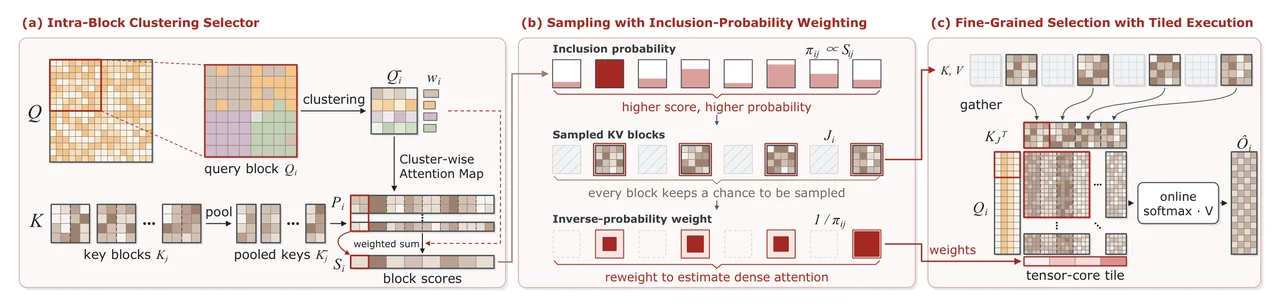
The method addresses a familiar sparse-attention tradeoff: dropping more blocks saves work, but coarse selection can lose information and degrade fidelity. AB-Attention combines local query clustering, block sampling with inclusion-probability weighting, and fine-grained gathering into GPU execution tiles. The weighting is intended to estimate dense attention rather than simply discard every unselected block’s contribution.
What the reported speedup measures
The English README describes a 600-prompt Penguin Benchmark evaluation, comparing quality with matched dense references and speed against matched dense FlashAttention-3 runs on NVIDIA H20. Its table reports denoising speedups of 2.01x for Wan2.1-T2V 1.3B, 1.84x for Wan2.1-T2V 14B and 2.23x for HunyuanVideo 13B.
Those are the authors’ measurements, not AITrending tests. Similarity metrics such as PSNR, SSIM and LPIPS compare accelerated output with the dense reference; they do not establish identical video output or a universal improvement in perceptual quality. The headline maximum also should not be read as a guarantee that every application or full production pipeline becomes 2.23x faster.
Public code, specific hardware
The MIT-licensed implementation targets Linux, Python 3.10 or later, PyTorch 2.6 or later, CUDA 12.4 and GCC 12. It explicitly requires Hopper GPUs with sm_90a support, naming H20, H100 and GH200. Inputs use BF16 with a head dimension of 128.
Installation involves cloning the repository and building the package with its FlashInfer integration after installing a CUDA-enabled PyTorch build. This is code for researchers and developers with the specified GPU environment, not a demonstrated drop-in acceleration for consumer graphics cards or every ComfyUI workflow. The small random-tensor quick start is an API smoke test; the video table supplies the project’s performance claims.