Claude designed 17 scorpion-toxin binders, Anthropic says. An antivenom is still unproven.
Anthropic reports laboratory binding results from an internal research model's design campaign and releases all 211 tested designs, while leaving toxin neutralization and animal efficacy untested.
Anthropic says an internal Claude research model designed proteins that bind four scorpion neurotoxins, producing 17 qualifying binders from 211 lab-tested designs. The company released the designs and experimental data October 20, offering researchers a concrete starting point for follow-up work on a neglected health problem.
The result is binding, not an antivenom. Anthropic says it has not tested whether the designs neutralize toxins in cells or protect living animals. The experiments used recombinant toxins produced in the lab, rather than toxins purified from venom. Safety, efficacy, affordability and delivery remain separate hurdles.
A 64-hour campaign with human direction
According to Anthropic, the model worked within Claude Science from an initial prompt developed with Citrini Research and four follow-ups. Over 64 hours it generated 318,484 protein designs and selected 180 for testing. The team added another 31 with Claude’s help, bringing the tested set to 211. The campaign used roughly 10,000 GPU hours, so the elapsed time should not be mistaken for a small-compute experiment.
Adaptyv Bio and Twist Bioscience performed binding assays. The released definitions require consistent hits and binding strength of 1 micromolar or tighter, along with an off-target check. There is an important exception to the two-lab requirement: LqhIII was assessed only at Adaptyv Bio.
The 17 qualifying designs bind individual toxins. None of the designs aimed at multiple toxins met the criteria for more than one, and none qualified against Ts1. This limits any inference about a broad antivenom cocktail.
Open data makes the next experiment possible
The CC BY 4.0 dataset includes all 211 designs, predicted structures, computational scores and experimental measurements. That release is useful independently of accepting the company’s wider claims about accelerating drug discovery. The results are Anthropic’s reported study, not an AITrending replication, and the post identifies an internal research model rather than a reproducible result from a specified public Claude version.
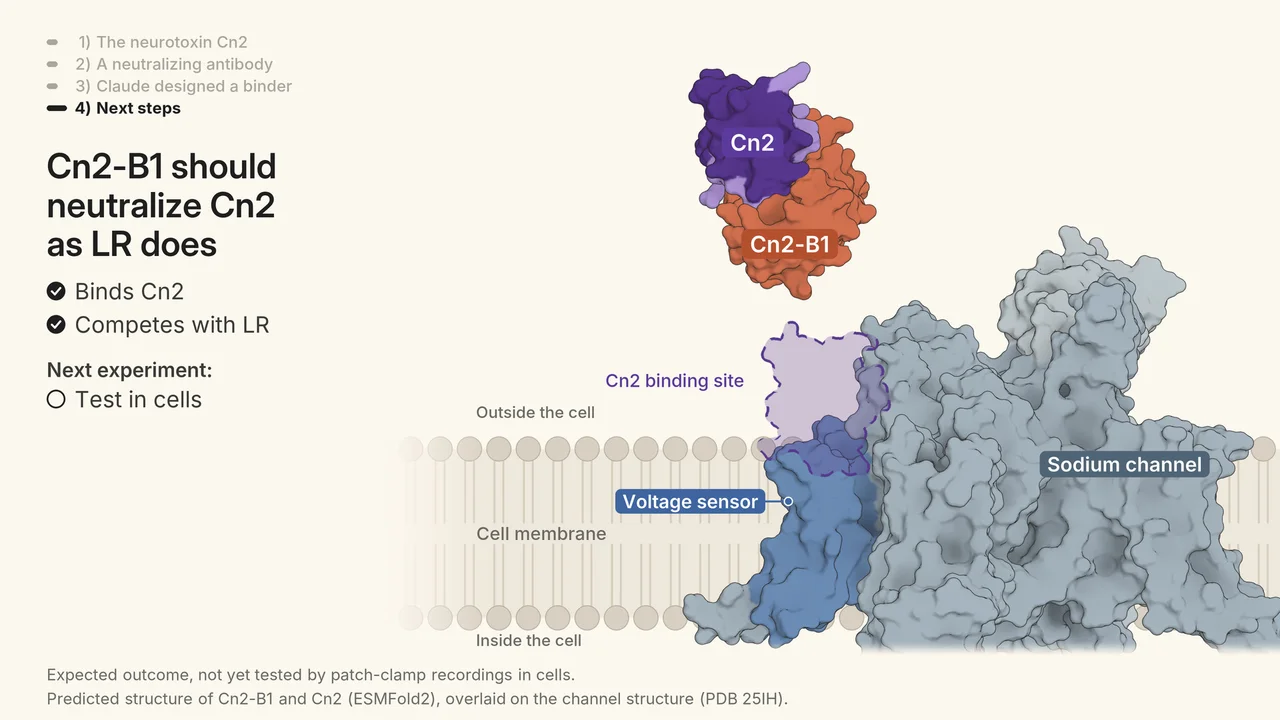
The author-published illustration shows why one binder might block Cn2’s action, based on its competition with a neutralizing antibody. Its own caption labels neutralization as an expected outcome that still needs testing in cells. The next milestone is therefore a functional neutralization result, not another rendering of a promising molecular fit.
Related reading
Claude Code's team moved review to agents, then capped the review loop
Anthropic says Claude traced decades-old ECDSA seeds to Unix timestamps