CoworkOS puts AI coworkers inside the same documents, CAD models and Blender scenes
A new research harness separates agent strategy from execution management, with shared editable artifacts, persistent memory and a reported five-round model-training experiment.
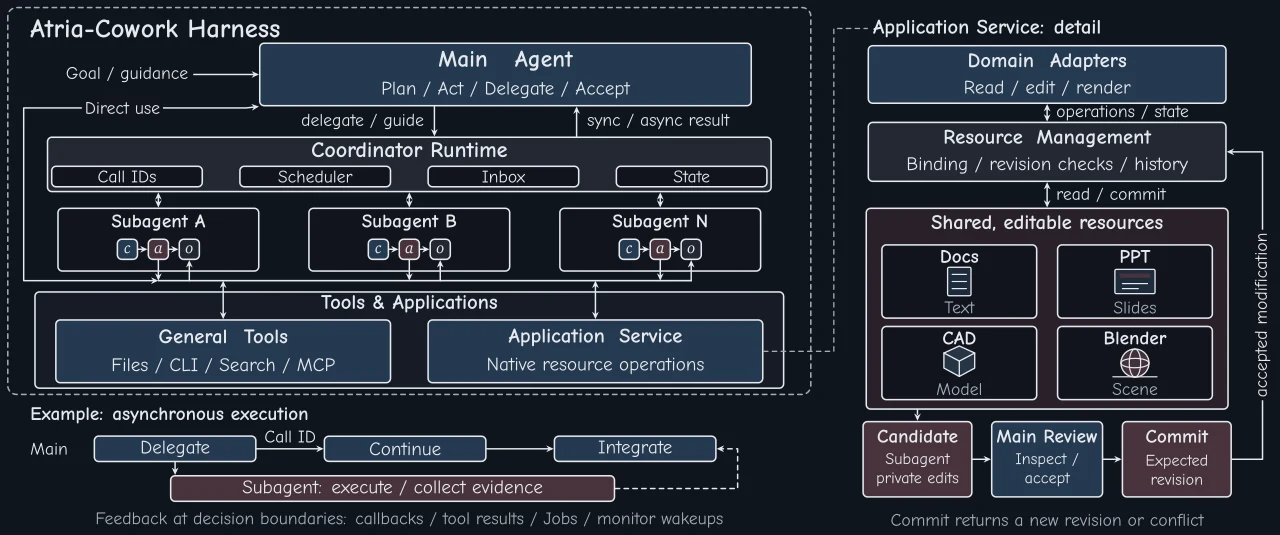
CoworkOS wants the AI coworker to share the work itself: people and agents can inspect and revise the same documents, presentations, CAD models and Blender scenes. Its November 2 research paper describes a harness for both complicated deliveries and work that continues across sessions, with a public project page, code and installation guides.
The design separates two jobs that often get bundled together. The model decides what to do, when to delegate and whether to accept a result. A runtime maintains execution state, coordination and feedback. A Main Agent can act directly or delegate through a Coordinator Runtime to subagents, synchronously or asynchronously.
Shared artifacts, with a way to return
The authors describe hierarchical workspaces, persistent semantic memory and long-running Job logs so files and decisions survive interruptions. Collaboration can happen through conversation or direct edits to the artifact. The English architecture guide describes revision checks and candidate changes reviewed before integration, including conflict handling that preserves manual drafts.
This is a local, single-user harness, with Pi integration documented in its architecture. Model services are configured separately. Users supply an API URL, model ID and API key; the service must support streaming and tool calls through the selected Responses or Chat Completions format. Native Anthropic endpoints cannot be used directly, and connection tests consume provider quota.
The CLI installation is npm install -g coworkos-app on macOS or Linux with Node.js 22.19.0 or newer, followed by coworkos init, a connection check and coworkos. The Mac app uses npx coworkos-app@latest desktop install and targets Apple Silicon with macOS 14 or later. Its guide calls the desktop a beta and says it has not been notarized by Apple.
A training-loop claim, not an independently reproduced result
As a sustained-work example, the paper reports using GLM-5.3 to drive five rounds of automated post-training on Qwen3.6-35B-A3B. The authors say its average across eight benchmarks rose from 33.19 to 42.95. Their project page notes that individual task gains and regressions vary. These are the team’s reported measurements; AITrending has not reproduced the training loop or benchmark comparisons.
The permission boundary also matters for a tool that can operate local applications. The architecture guide says Computer Use needs Screen Recording, Accessibility and explicit window access, with the latter allowing conversations to observe and control visible application windows. It explicitly cautions that its grants do not prove bash and background jobs are confined by a universal operating-system sandbox.
For developers evaluating agent coworkers, the concrete attraction is an inspectable design for shared artifacts and recoverable delegation. The published docs also identify unfinished areas, including broader real-source monitoring and sustained-run evaluation. Those roadmap items should not be confused with demonstrated unattended reliability.
Related reading