CVE Intel adds MLX: local vulnerability Q&A gets an Apple-silicon route
Version 0.3.10 adds managed MLX installation and small model options on M1-or-newer Macs, alongside the app's existing llama.cpp and MCP workflows.
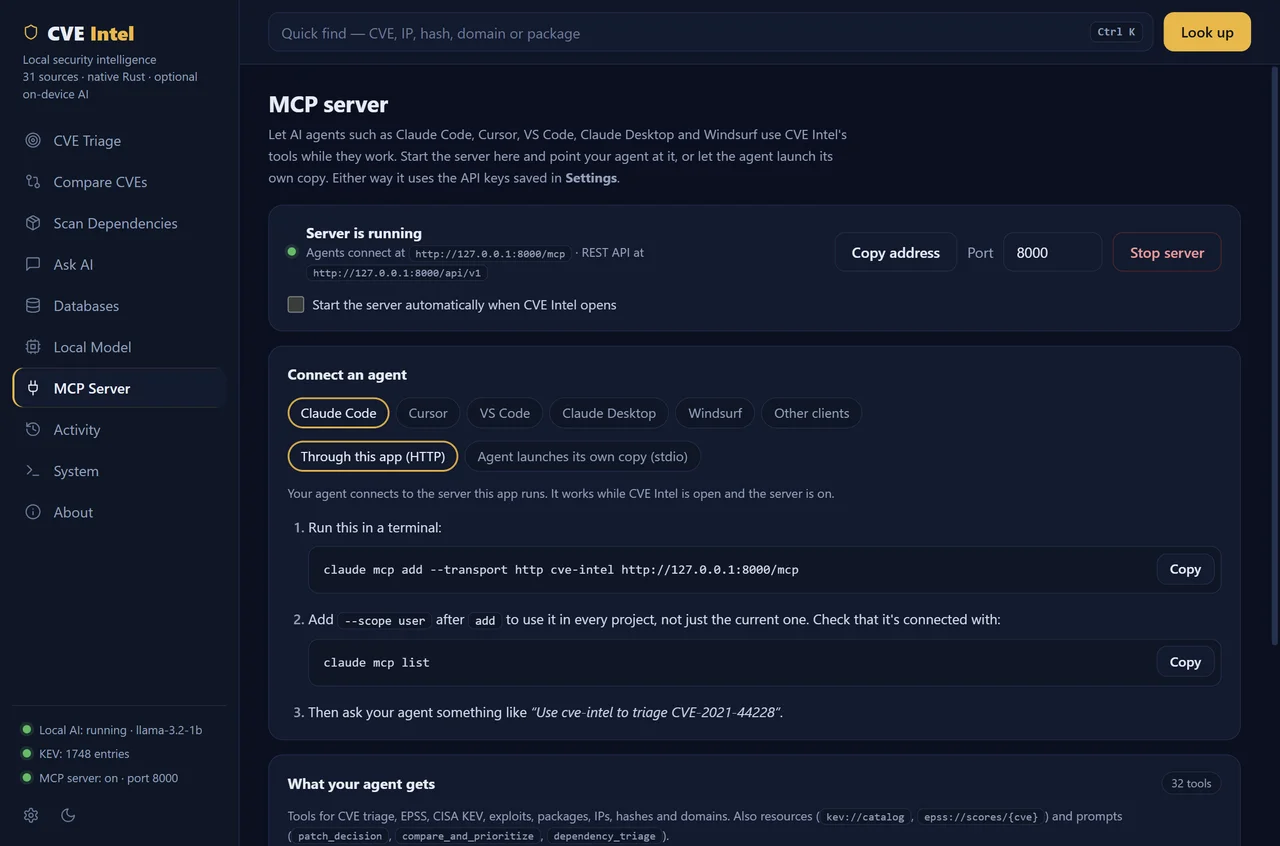
CVE Intel now gives Apple-silicon users an MLX option for asking local models about vulnerability evidence. Version 0.3.10, released October 20, adds runtime installation, model catalog entries and process management alongside the existing llama.cpp path. The code change is a new inference option inside the security tool, not a new vulnerability database or a faster-model benchmark.
The app’s workflow gathers facts first: give it a CVE, suspicious indicator or dependency list, then use the resulting evidence for triage. Its optional Ask AI layer explains lookup results, and its existing MCP server lets coding assistants call the security tools themselves. Those are separate routes: adding MLX to the app does not replace the model used by a connected Claude Code or Cursor session.
What changed for a Mac user
The tagged implementation offers MLX only on macOS with Apple silicon, M1 or newer. It includes 4-bit MLX-community builds of Qwen 2.5 1.5B Instruct and Llama 3.2 1B Instruct. Its installer creates a private Python 3.12 environment under ~/.cve-intel/mlx/, using uv and installing mlx-lm; it can also detect an existing runtime. Model files live in the app’s local model directory.
The model server binds to loopback. The MLX launch uses downloaded model folders with Hugging Face offline mode enabled, rather than silently resolving another model during inference. Other platforms retain the llama.cpp route. The version’s README still describes local setup mainly in llama.cpp terms, so the release comparison and tagged runtime code are the evidence for the MLX addition.
Local inference still uses public intelligence
The MIT-licensed application is a Rust/Tauri desktop tool with CLI, REST and MCP interfaces. Release downloads include Windows, macOS universal and Linux packages; the tagged installation guide warns that builds are not code-signed. A local model needs no paid inference API key, but downloading its runtime and weights uses the network and storage. Security lookups still query public sources, with optional saved data-source keys enabling more access or higher limits.
For coding agents, the existing server supports HTTP or stdio and reuses the configured source keys. The app is a tool provider to those harnesses, not a plugin that supplies their model subscriptions. Opting into a cloud AI provider sends questions and gathered lookup results to that provider under its terms.
AITrending inspected the release and implementation but did not run the Mac application or measure MLX speed. Risk scores and generated explanations remain aids for checking evidence; this release does not establish that a machine has been scanned, a patch applied or an answer independently verified.
Related reading
Auto Browser patches desktop-access and approval-replay gaps
Mnemosyne's new preview makes stale-memory holds reviewable