Doomformer makes DOOM run a neural network, one voodoo doll at a time
A community project turns integer neural networks into game maps where moving player copies do arithmetic, with digit drawing and tiny transformer demos.
DOOM can run a neural network if you turn the network into a DOOM map. That is the delightfully impractical premise of Doomformer, a community experiment drawing fresh Hacker News discussion after a submission on October 29.
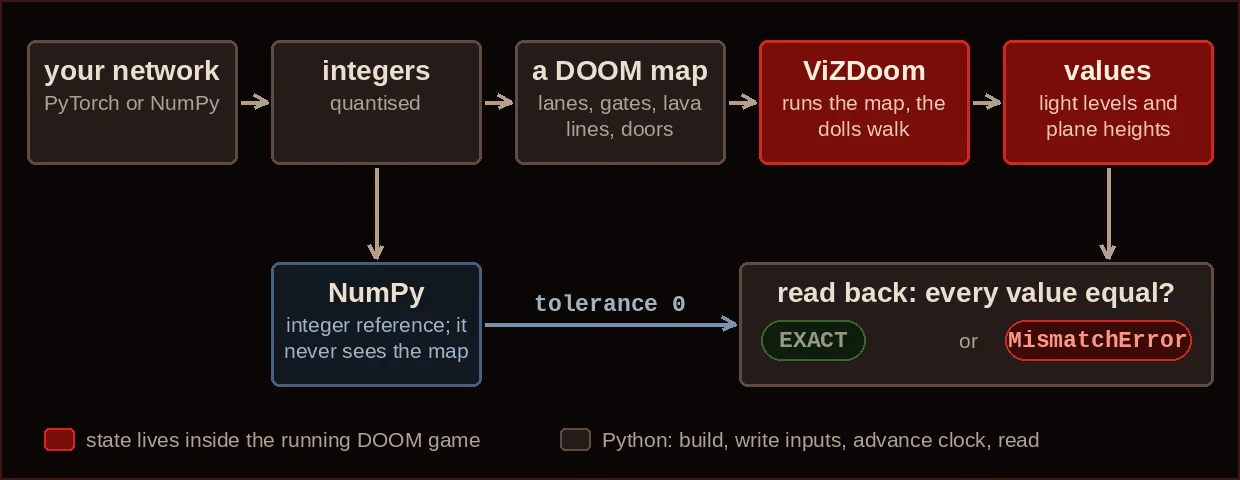
The project compiles supported integer networks into ZDoom maps. Extra copies of the player, known as voodoo dolls, cross lines that trigger arithmetic. Sector light levels and floor or ceiling heights hold numbers, while gates and staircases implement parts of the computation. ViZDoom runs the maps using Freedoom assets. This uses a later DOOM-compatible engine, rather than the original 1993 executable.
Draw a digit, let the map classify it
The author’s examples include small multilayer perceptrons, MNIST digit recognition and tiny transformers that generate level names. One interactive demo lets a player walk a digit onto a 28-by-28 floor and ask the map to classify it. Other experiments use network outputs to control a marine.
The interesting claim is that the game mechanics perform the arithmetic. Python still builds the map, supplies inputs and reads exposed values. The project compares those readings against an independent NumPy integer reference with zero tolerance. An “EXACT” result means agreement on the tested integer computation; it does not establish that the prediction is correct or that every possible compiled network works.
Nor is this a practical inference accelerator. The author reports a small MLP whole-call benchmark around 65,000 times slower than NumPy. AITrending has not reproduced that measurement. The transformer conversion route supports the project’s own quantization-aware GPT recipe, not arbitrary pretrained language models.
A runnable experiment, with setup required
The English README documents Python 3.11 or later on Linux and macOS. Installation uses pip install git+https://github.com/mottopanikeiku/doomformer; doomformer hello and doomformer draw --digit 7 are entry points. The first build needs development tools and network access. Local execution requires no hosted model API key, but still consumes local compute and memory.
The release feed dates v0.7.1 to October 28. The October 29 HN post is the new attention signal, not the original launch date. Current documentation also discusses unreleased work, which should not be mistaken for features shipped in that tag. For readers who enjoy seeing where computation can happen, the map itself is the attraction.