Elpis gives Linux coding agents a desktop—and their own folders
The Codex-based harness adds editable agent teams and review steps, with an AppImage follow-up and explicit limits on folder isolation.
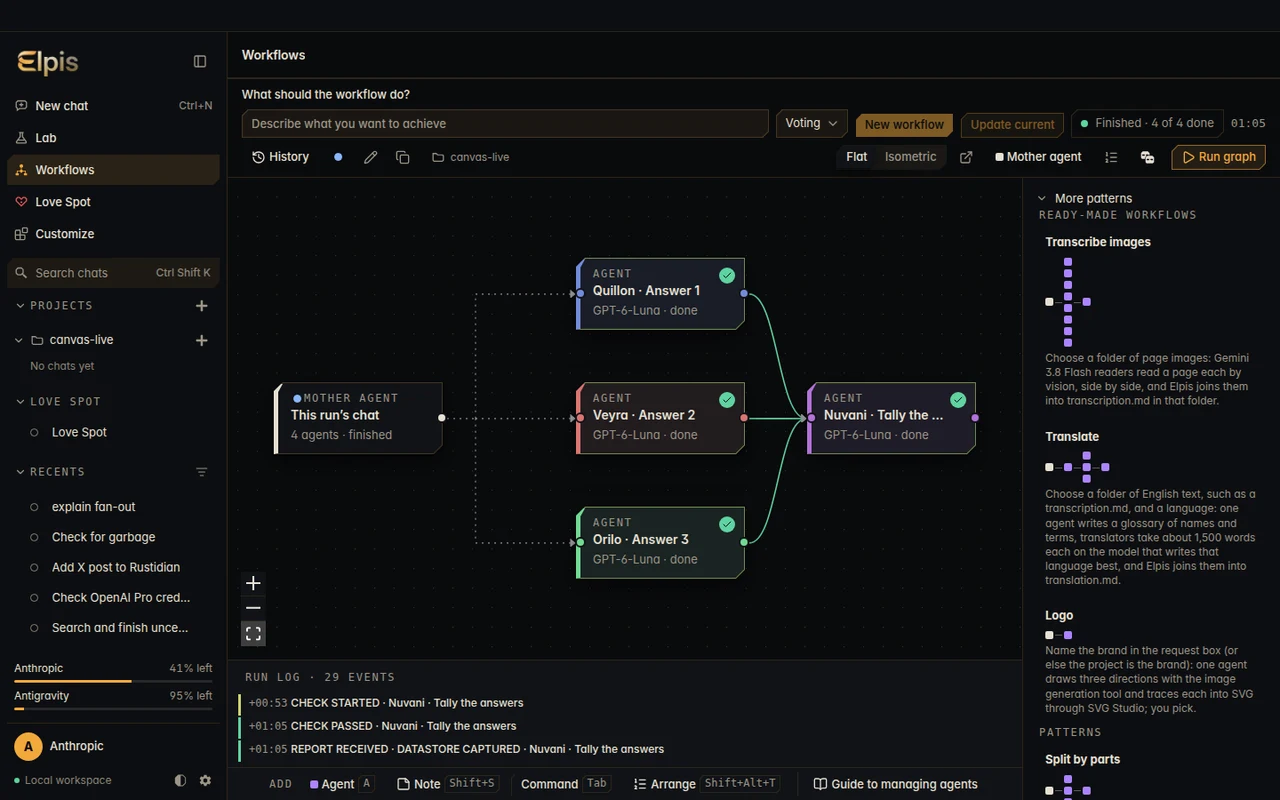
Elpis wants a team of coding agents to work from a visible board, with each writer assigned its own territory. Version 0.5.0 introduced the project’s first desktop app on November 3 at 10:59 UTC. A 0.5.1 follow-up at 14:53 UTC added a combined AppImage and fixed early desktop issues.
The Linux application is a harness built on OpenAI’s Codex CLI, rather than a new model or an official Codex desktop release. Its desktop and terminal apps share an engine. Users can connect ChatGPT or Claude accounts, or configure a provider; Claude models run through the user’s own Claude Code installation. No model weights are bundled.
A planning agent builds the team; checks gate the result
According to the tagged English README, the planning agent, called Mother, can design an editable team with different models for different jobs. The board supports sequential work, parallel waves, bounded recursive patterns and voting. A writer without a following check is refused, and the planning agent reviews the combined result before it reaches the project.
The practical distinction is the documented ownership mechanism. In a Git project, agents work in separate worktrees, and a step fails if it changes files outside its assigned folders. Agents explicitly linked to run alongside one another cannot share a folder. The final integration refuses to proceed if the project has moved or the reviewed commit changed.
Those checks have boundaries. Two parallel agents without an explicit alongside link are not yet checked for folder overlap before running, although the project says Git catches overlap afterward. Outside a Git project, folder assignments are instructions rather than enforced boundaries. The documentation therefore does not support a blanket claim that every agent is isolated from every other agent.
The app also exposes a Context Ledger for including or excluding instruction files, chosen files and memories, with their token costs. Smart Prune and reasoning expiry remain experimental.
Linux packages, existing accounts and a maintenance caveat
The release targets Linux x86_64. Ubuntu and Debian users install both the terminal and desktop .deb packages; the 0.5.1 AppImage contains both applications for other Linux distributions. The author reports installing and opening packages on clean Ubuntu 24.04, Debian 13, Fedora 42 and Arch. No macOS or Windows build is claimed, and that test report is not proof of compatibility with every Linux setup.
State is stored under ~/.elpis-next by default. Model access depends on the user’s existing subscription or API credentials, with associated provider costs. Elpis retains Apache-2.0 licensing and upstream attribution.
There is also a maintenance caveat: the 0.5.0 note calls it the maintainer’s last release, although 0.5.1 followed later that day. The reviewed sources do not establish a continuing release commitment. AITrending reviewed the English release notes and tagged documentation; the workflow behavior and supplied illustration are the project’s account, not an independent AITrending test.
Related reading
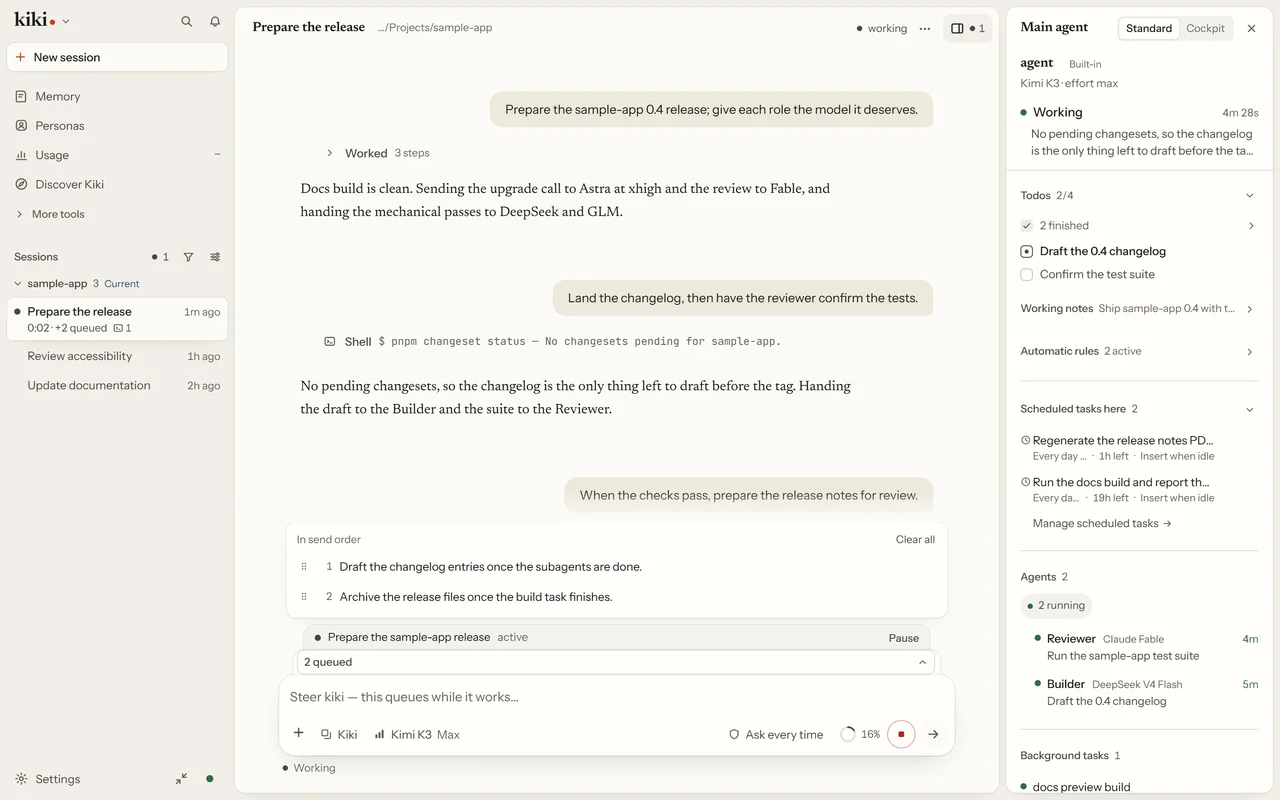
Hivemind wants Claude Code to find your teammate's fix when a command fails
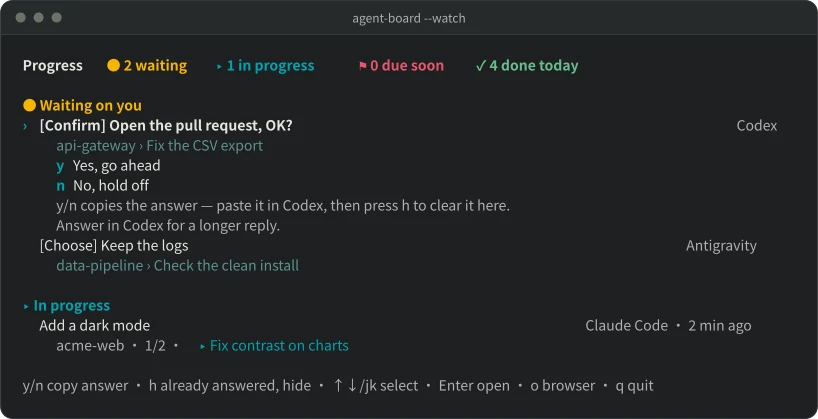
Agent Board 0.24.2 keeps lookalike agent sessions from stepping on each other