Tencent's Hy-Nomas puts steerable video worlds within reach of a single RTX 4090
A new technical report details an 8B interactive world model, downloadable weights and low-memory video inference; the full web demo needs additional serving resources.
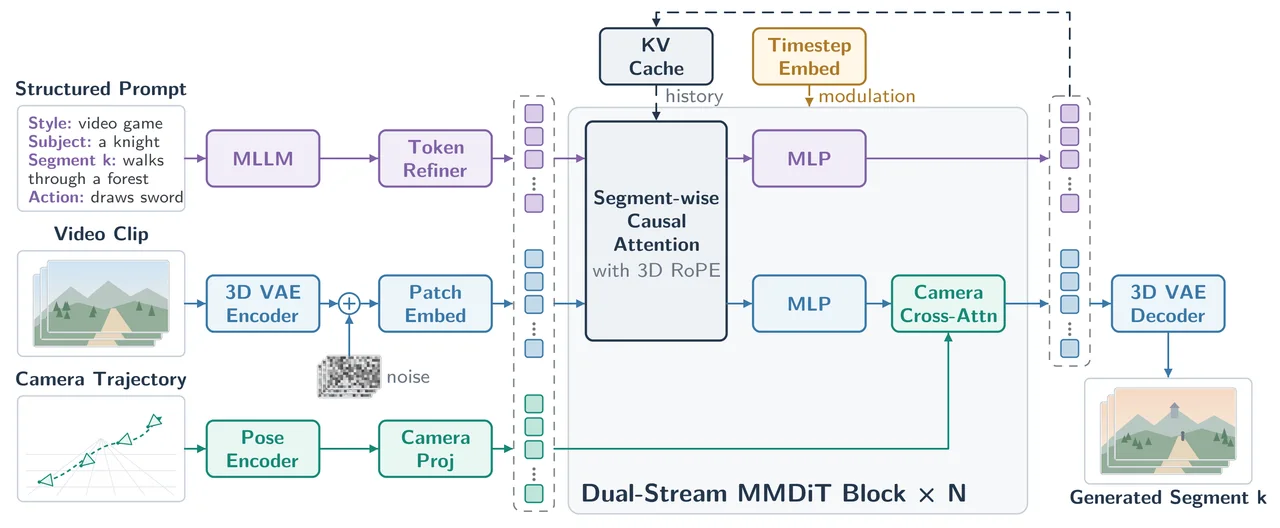
Tencent Hunyuan’s Hy-Nomas offers a compelling route into steerable video worlds: downloadable weights, text and camera controls, and a documented video-inference configuration for a single NVIDIA GeForce RTX 4090. A technical report submitted to arXiv on October 27 describes the model’s 8B diffusion backbone and how it carries interaction history between generated segments. The report is the new research milestone; the model repository was already public before it appeared.
Instead of generating one fixed clip and starting over, Hy-Nomas accepts instructions as a world continues. Users can introduce objects, change a scene or style, describe actions and supply camera movement, according to the authors. Cached history conditions later segments. The project also provides a benchmark for interactive control and consistency, along with code and weights for research and adaptation. These are author-described capabilities, not independently reproduced AITrending results.
The single-GPU route is particularly relevant to local-video builders. The English model card specifies INT8 diffusion-model weights and cache storage, a compatible FP8 PixelUMM decoder, bounded history on the GPU and CPU offload. This makes system memory and transfer overhead part of the setup. Peak GPU memory still depends on resolution and segment length; fitting the model is not a guarantee of instant generation.
There is an important distinction between running video inference and hosting the complete interactive interface. The web demo requires Nomas-PE, a separate prompt-enhancement service that converts user requests into structured conditions. Its GPU resources must be counted separately. Offline inference can instead consume prepared prompt files. The recommended environment is a Linux host with NVIDIA drivers, Docker and NVIDIA Container Toolkit; manual installation has additional Python, CUDA and compiler requirements.
The card’s standard configuration produces 720-by-1280 video at 24 FPS with eight denoising steps. That frame rate describes playback, not how fast a particular computer generates the frames. The standard distributed configuration also differs from the low-memory single-GPU preset. The project identifies Apache-2.0 licensing while noting that third-party components keep their own terms.
Current public English attention includes a Hacker News submission and an author post on the Hugging Face paper page. The author compares its features with Genie 4, but that statement does not establish equivalent quality, latency or capability. Hy-Nomas is worth examining because builders can inspect and run its published components, with the single-GPU and complete-demo requirements kept distinct.