Mercury 3 launches with a million-token context and a 1,068-token/s speed claim
Inception's diffusion model is available through its API and partners, with a 50% introductory discount. Its speed and quality comparisons remain company-reported results.
Inception has launched Mercury 3, a diffusion language model with a one-million-token context window and a company-reported output speed of 1,068 tokens per second on NVIDIA GPUs. The October 19 announcement says the model is available through Inception’s API, OpenRouter, Baseten and Vercel.
The practical pitch is faster feedback in applications that call a model repeatedly: browser agents, tutoring, search and customer support. Inception says Mercury 3 is more than 40 times larger in total parameters than Mercury 1 while maintaining high generation speed. The announcement does not disclose an absolute parameter count.
The price and access route
The stated standard price is $0.20 per million input tokens and $0.70 per million output tokens. At launch, Inception is offering a 50% discount: $0.10 for input and $0.35 for output. It also advertises a 90% discount on cached input tokens. The announcement does not give an end date for the introductory pricing, so developers should check current terms before budgeting a deployment.
Inception’s English quick start uses mercury-3 at https://api.inceptionlabs.ai/v1/chat/completions. Users create an account and API key; the documentation advertises 100 million free tokens for new accounts without payment details, followed by billing setup for continued paid usage. An OpenAI-compatible interface gives existing clients an integration route, but is not a guarantee that every application’s behavior is unchanged.
The reviewed release provides hosted access. It does not announce downloadable weights or an open-weight license. A one-million-token context limit also describes capacity, not proof that every long-document task is solved correctly.
Fast generation is one part of an agent
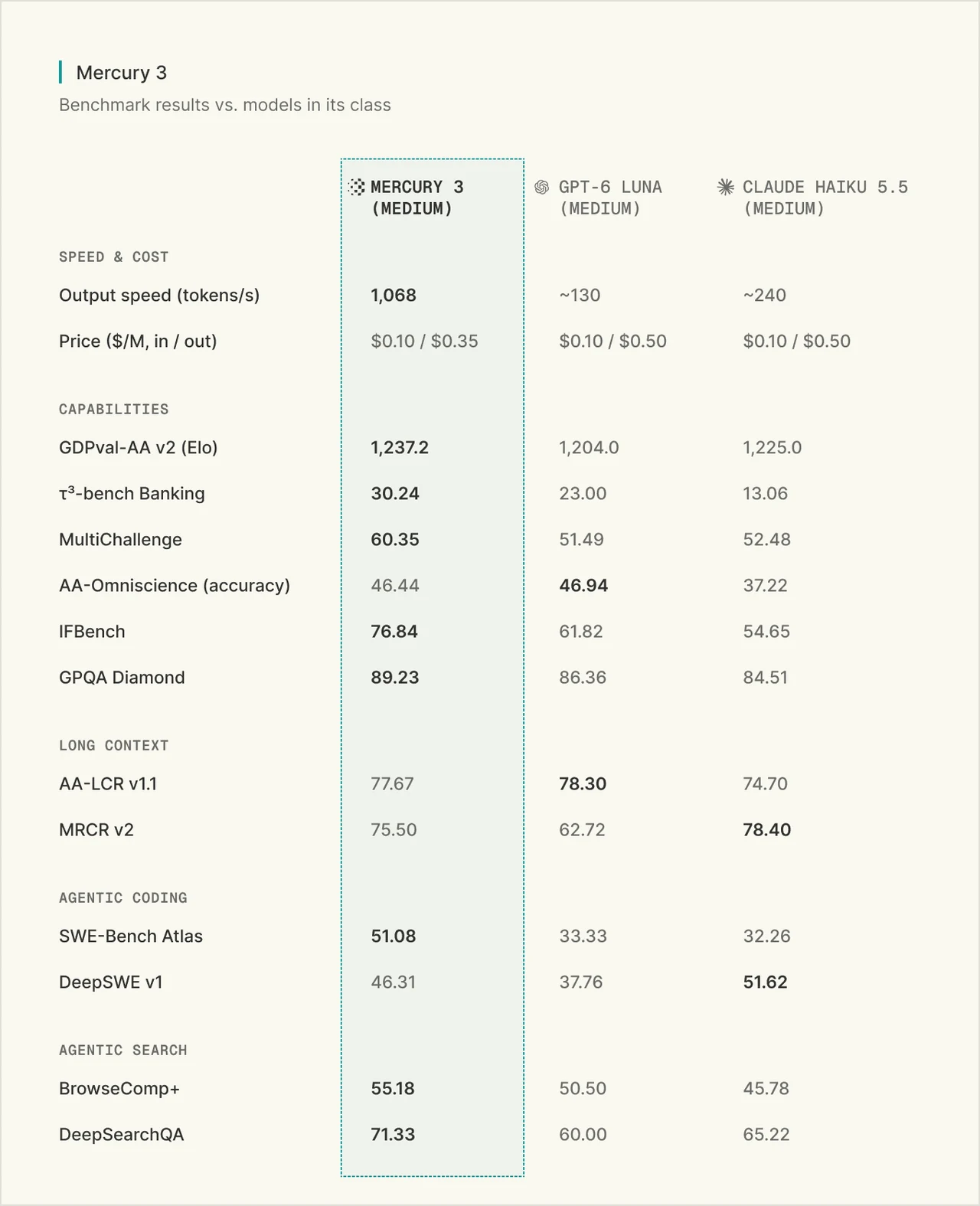
Inception compares Mercury 3 with GPT-6 Luna and Claude Haiku 5.5 and reports stronger results across several evaluations. Its own table also shows exceptions: Mercury 3 trails another listed model on some long-context and coding tests. The chart is a vendor comparison, not a universal ranking or an AITrending reproduction.
The announcement includes a TinyFish testimonial reporting 50% completion across 50 live Mind2Web tasks in its production web-agent harness. That result belongs to the partner’s stated setup. It should not be transferred to arbitrary browser tasks, other harnesses or different serving conditions.
Generation throughput alone is not end-to-end application latency: network requests, tools and the number of agent steps still matter. Mercury 3 gives developers a newly available model to evaluate against those actual workloads. Its launch claims are a reason to test that tradeoff, not evidence that every agent will run four to eight times faster.
Related reading
PigPig 3.5 turns its Discord AI into a music controller
AgentpitBench puts coding agents' paper-money bets and transcripts on Hugging Face