Le Chonk is downloadable now, with a license caveat for model providers
Mistral has released Large 4 weights and serving recipes, moving Le Chonk beyond its preview while reserving separate commercial licensing for model-as-a-service businesses.
Storyline / Report 2 of 2
Mistral Large 4 preview and public weight release
Full timeline 2 reports
- DevelopingMistral announces Large 4, with public weights planned for October 27
- Source-backedLe Chonk is downloadable now, with a license caveat for model providers (current report)
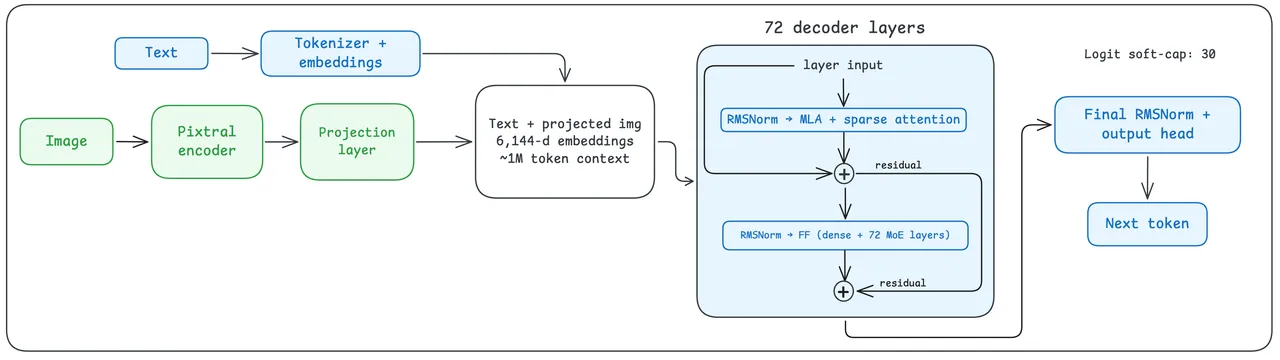
Mistral Large 4, nicknamed Le Chonk, has moved from preview to downloadable weights. Mistral’s October 29 announcement releases an improved version of its flagship multimodal model, with official serving instructions and a license that permits self-hosting but places conditions on model-as-a-service businesses.
This is the access change anticipated in the earlier Large 4 announcement, rather than another report that weights are merely planned. The official Hugging Face repository now exposes the checkpoint files publicly. Its repository creation date is September 30; that storage date is not the public-release date established by the new announcement.
A large model with sparse computation
The model accepts text and images and generates text. Mistral describes roughly one trillion total parameters, with 49 billion active per token, or 52 billion when embeddings and output layers are included. Its advertised context window is one million tokens.
The official card supports low, medium and high reasoning effort, with high as the default. It also documents tool calling and structured JSON output. Mistral positions the release for coding, defensive cybersecurity and enterprise workflows. Its comparative performance and safety statements are vendor claims; downloading weights does not establish that a particular agent or deployment will achieve those results.
Self-hosting has concrete infrastructure requirements
Mistral supplies vLLM and SGLang serving recipes, plus Transformers instructions. Its example production configurations distribute the model across eight GPUs. The official NVFP4 variant targets NVIDIA Blackwell hardware; selecting a smaller numerical format is not a promise that the full model fits a typical laptop.
Hugging Face’s guide also describes community GGUF conversions and llama.cpp support. Those are separate artifacts and deployment paths from Mistral’s official checkpoints. Its published performance examples depend on the chosen quantization, hardware and context length, so they should not be read as a universal local inference speed.
For coding-agent users, the official model card explains how to connect Mistral Vibe to a local vLLM server. Hosted use through the Mistral API remains another option and requires an API key. Model serving and the agent harness remain separate components: the checkpoint itself does not supply repository permissions, command approvals or an application security boundary.
Open weights with a commercial condition
The Mistral Ecosystem Open-Weight License is a modified MIT license, rather than an unmodified permissive MIT grant. It permits use, modification and redistribution, but says a licensee or affiliate operating a model-as-a-service business must obtain a separate commercial license before commercial use of the model or derivatives. The text includes exceptions for internal use and access through Mistral’s official products.
The practical change is meaningful: organizations can now inspect and deploy the public weights instead of depending solely on preview access. Teams planning to expose a configurable inference or post-training service should read the actual license definitions and exceptions before treating the release as unrestricted hosting permission.
Related reading
Rexpad puts a coding agent’s live plan beside its terminal
Anfra lets AI-built dashboards show the rows behind a chart