This Qwen remix targets AI writing tics, claiming a 42% lower 'slop' score
RefinedNeuro's new weights target formulaic English prose and keep MTP support, but the author says the punctuation gains do not carry into coding-agent sessions.
A new community Qwen remix wants to remove the voice that makes a chatbot sound like a chatbot. RefinedNeuro’s Qwen3.8-27B-noslop targets stock phrasing, assistant-style framing, recurring fictional names and excessive dash punctuation through modified weights, rather than a prompt filter.
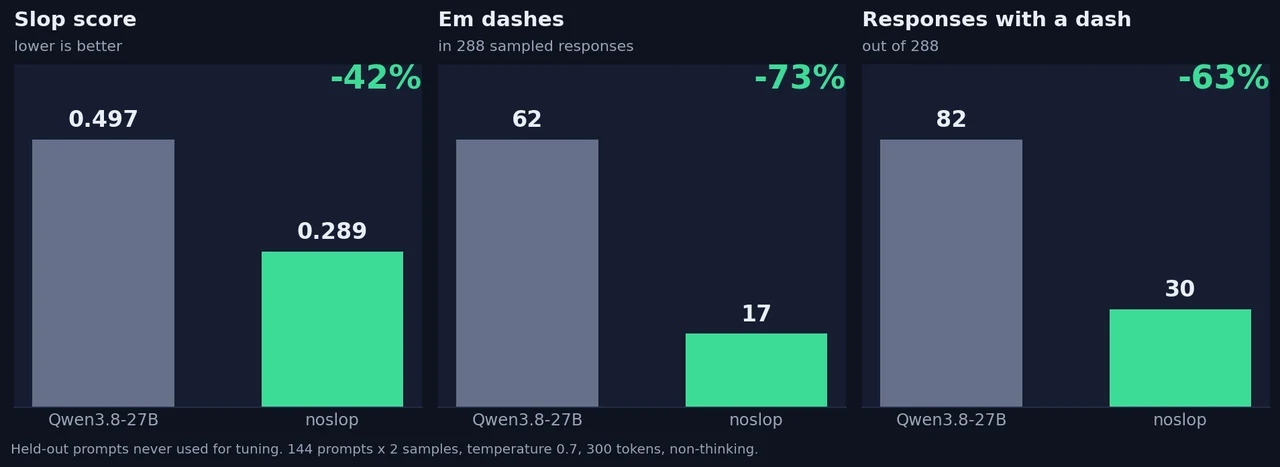
The author reports a 42% reduction on a custom writing-style score and 73% fewer em dashes in sampled English writing responses. Those figures describe the project’s own evaluation, not an independent verdict that the model writes better in every setting.
The full-weight repository was created October 21 at 19:44 UTC and its GGUF companion at 20:23 UTC. The October 22 review found downloadable weights and detailed methodology, making this a concrete community model release rather than a new release of Qwen’s underlying model.
The change lives in the weights
RefinedNeuro describes using Heretic’s Arbitrary-Rank Ablation to produce a rank-50 adapter, then merging it into the original bf16 weights. The contrast pairs plain-writer instructions with deliberately exaggerated AI-style instructions. The author says the architecture, tokenizer, chat template, vision tower and multi-token-prediction head are retained.
The reported writing comparison uses 144 prompts with two samples each, temperature 0.7, a 300-token limit and thinking disabled. Mean custom-detector score falls from 0.497 to 0.289, while em-dash counts fall from 62 to 17. The scorer counts a hand-weighted lexicon and writing patterns; it is a proxy for the author’s preferences, not a universal measure of prose quality.
The methodology says eight finalists were compared on the held-out sampled split to choose the released checkpoint. That split therefore helped select the final model, even though the optimizer did not train against it. The report also describes only one search seed and warns that small differences may be noise.
Five GGUF downloads are present
At revision b93b0bf46aece0988c7a3b9a4d15eedc00e79989, AITrending found Q2_K_XL, Q2_K_M, Q3_K_XL, Q3_K_M and Q4_K_M files. The smallest is about 9.83 GB and Q4_K_M about 16.81 GB in decimal units. These are download sizes; context cache, runtime overhead and image support require additional resources.
The card advertises a sixth Q8_0 option, but that file was absent from the reviewed listing. Its llama.cpp recipe uses --spec-type draft-mtp for speculative decoding and requires a build supporting that option. Images need a separate compatible vision projector, according to the instructions.
The writing gains have a boundary
The author reports matching hidden-test pass counts against identically quantized base weights in pi and Claude Code: 23 of 24 and 22 of 24 runs respectively. This small comparison does not establish unchanged general capability.
More directly relevant to the headline, the card says dash punctuation remained in roughly 85% to 90% of coding-agent final messages, much like the base. It also reports three pi runs that kept re-verifying finished work until timeout, a possible regression the author calls suggestive rather than statistically established. Thinking-mode text was neither optimized nor evaluated.
For local writers, the release offers a specific experiment in changing model style. AITrending verified the English documentation and available file metadata, but did not run the weights or reproduce the reported gains.