Flint puts a coding agent on your Mac; Recursive says AI helped build the model itself
Apache-licensed weights arrive with a local engine for PI and OpenCode. Recursive claims more than 125 tokens per second on an M4 Pro, but its dedicated Mac runtime needs at least 48 GB of memory.
Recursive’s first coding model comes with a practical invitation: run the agent on your own Mac. Flint, released October 21, has 39.8 billion total parameters and activates approximately 2.5 billion per token. Its weights use Apache 2.0, and the company is releasing a dedicated inference engine, rec, with ready-made PI and OpenCode workflows.
The second hook is how it was built. Recursive says its Eureka Machine proposed ideas, implemented experiments and used the results to guide further research across the model-building stack. The company attributes contributions in architecture, quantization, training and specialized kernels to that system, saying a small team of people and agents built Flint from scratch in under four months. That is an account of supervised automated research, not a demonstrated autonomous cycle of unlimited self-improvement.
The laptop route has specific requirements
The rec README lists M4 Pro, M5 Pro and M5 Max Macs, at least 48 GB of unified memory and about 30 GB of free disk space. PI also requires Node.js 22 and npm. This does not establish compatibility with every Apple Silicon laptop.
After installation, rec launch pi or rec launch opencode starts the server and attaches a separate harness. The first run downloads the model and harness. The server keeps running after the terminal closes; rec stop shuts it down. Custom clients can use the local OpenAI-compatible API and an authentication token generated by rec.
The engine is optimized for a single session. Running many agents at once is a separate deployment choice. The model card’s BF16 route is also different: its approximately 80 GB download and SGLang kit target a B300 or H200 GPU, rather than the Mac quantized setup. Transformers modeling code is not included yet.
Speed is a company measurement
Recursive claims more than 125 tokens per second on an M4 Pro and more than 150 on a 64 GB NVIDIA RTX Spark at short contexts with its optimized inference stack. These figures are not guarantees for arbitrary hardware, long prompts or complete agent jobs. Its engine throughput comparison excludes prompt prefill.
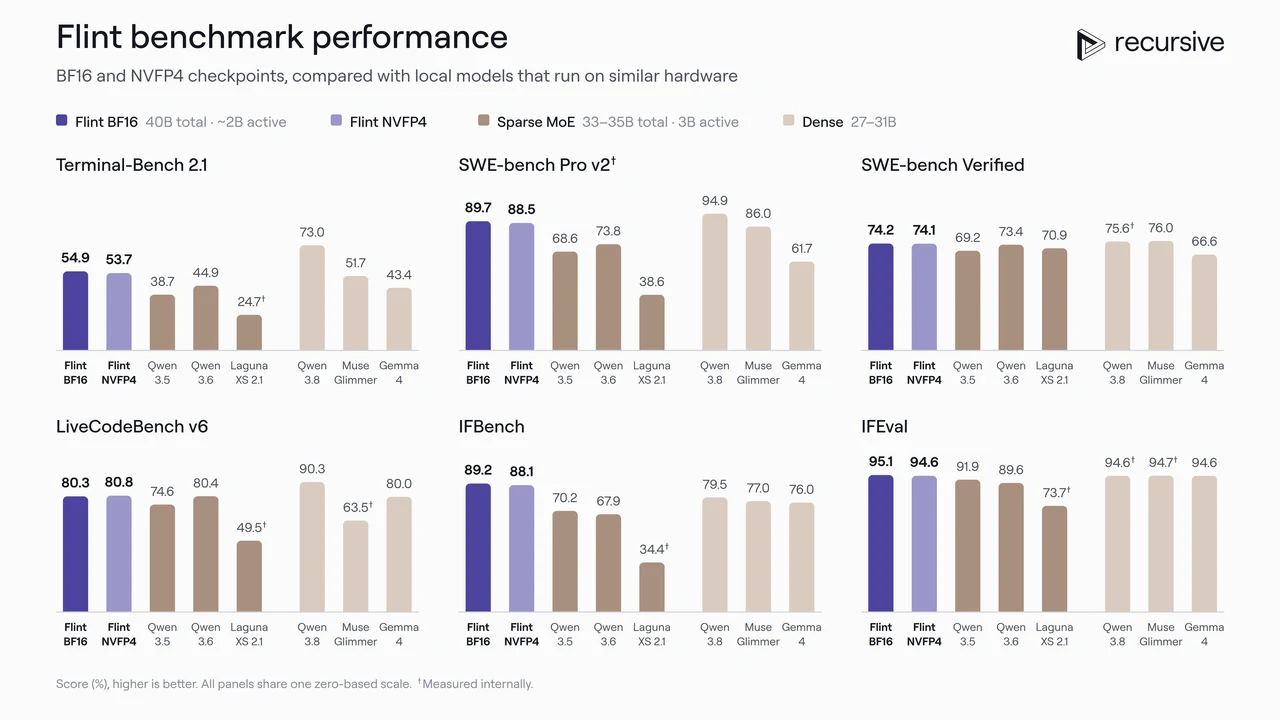
The model card reports 54.9% on Terminal-Bench 2.1, 89.7% on SWE-bench Pro v2 and 74.2% on SWE-bench Verified. Agentic evaluations use specified harnesses and average pass@1 over at least five attempts; comparison setups can differ. AITrending has not reproduced these results or tested the engine.
The announcement advertises up to 512,000 tokens of context while recommending staying within 256,000 for best results. The released card documents a 262,144-token configuration shared by prompt and output. Users should check their actual checkpoint and runtime rather than assume the largest advertised window is enabled everywhere. Recursive also advises breaking complex work into smaller tasks and giving explicit instructions.
Local inference avoids a remote model API bill, but still uses the owner’s hardware and electricity. A coding harness can execute tools and modify files; applications must enforce their own permissions, and generated code still needs review. Apache-licensed weights do not make every tool action private or correct automatically.
Related reading
Rexpad puts a coding agent’s live plan beside its terminal
Anfra lets AI-built dashboards show the rows behind a chart