Reticle makes coding agents back up 'done' with runtime evidence
The project's new Show HN introduction pitches an inside-app proof layer, saved flows that replay without a model, and explicit answers when a check cannot decide.
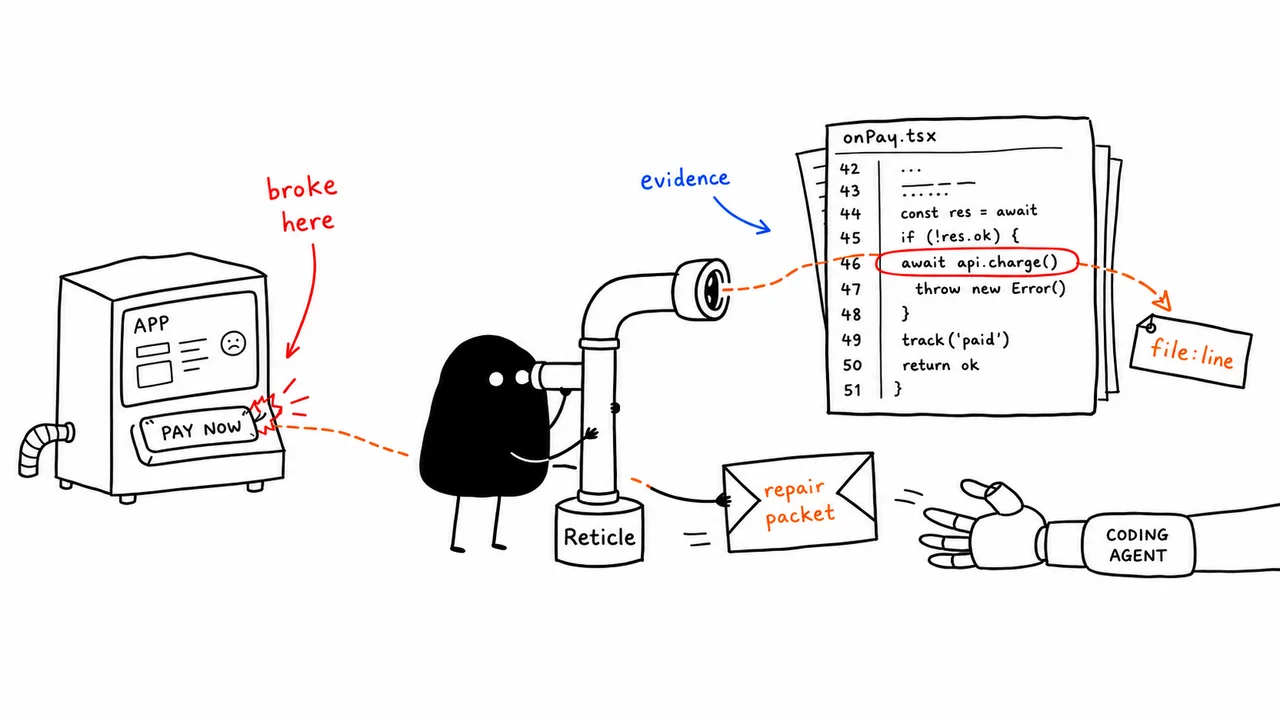
Reticle wants an AI coding agent’s claim that it is done to come with evidence from the app it changed. Its October 20 Show HN introduction puts a practical workflow in front of developers: drive the running app, inspect the consequences, and save a journey that can be checked again without another model navigating every step.
The project is not a new coding model. It combines a development SDK inside an app with a local bridge and MCP tools for assistants such as Claude Code, Cursor, Codex and OpenCode. According to its documentation, checks can inspect requests, console events and registered application state, then return a verdict and a relevant source location. A payment button that looks successful while its request fails is the kind of mismatch it targets.
Only verified: "yes" counts as a pass. unknown means the evidence cannot decide. Saved flows replay without a model in the loop, while the separate optional hosted Harness uses AI to explore a described journey. Those are different execution paths, not a promise that all testing consumes no model tokens.
What installing it changes
The current README requires Node 20.11+ and a locally running app. It recommends a Claude Code plugin for that host, or npm install -g @reticlehq/server followed by MCP setup for other agents. reticle init --dry-run previews project changes before installation.
Actual setup adds development dependencies, build integration, agent instructions and, where supported, prompt-capture hooks. The documented bridge listens on loopback with a pairing token. Local verification needs no Reticle account; the hosted Harness uses an account and credits, and enterprise production features require a license key.
The privacy boundary matters. The project says app observations stay local until a project is linked, but anonymous usage telemetry is enabled by default. Linked projects share captured requests with runs by default. --no-prompt-capture skips the hook, "shareRequests": false keeps requests local, and reticle telemetry disable disables telemetry. The prompt guide explicitly says redaction is pattern matching, not proof that every secret is removed.
Support is narrower than a framework list
Reticle’s framework guide distinguishes tests that drive React + Vite and Next.js to a verdict from Remix and Astro checks that boot an example and require a session. Several other stacks have installation gates only; some are merely wired and documented. That is more useful than treating every named framework as equally verified.
The README also lists blind spots including IndexedDB, Web Workers, closed shadow roots and cross-origin iframes. Its benchmark comparisons are author-run tests on a controlled app, not independent evidence that Reticle replaces cross-browser, visual, accessibility or security testing.
Licensing is split: the SDK, core and engine are Apache-2.0, while the server, CLI and spec runner are source-available under FSL-1.1-ALv2, converting to Apache-2.0 after two years. The v3.7.0 release was published October 13. The current news hook is its fresh community introduction and workflow discussion, not a newly dated release or demonstrated popularity surge.
Related reading
Nexus-CLI brings a DeepSeek web account to coding agents and Ollama clients
Bodhiorchard brings Ollama and HR into its self-hosted Jira alternative