RPO reports up to 4.2x lower video RL training cost by routing attention
NUS and ByteDance researchers move exploration inside attention while keeping the generator's sampler intact. Wan2.2 results use 24.1 H100 GPU-hours; code is still planned, and the comparisons are not compute-matched.
A different place to explore
Routing Policy Optimization, or RPO, offers a new way to train image and video generators with reinforcement learning: vary which attention routes they use during training, then remove those temporary masks for generation. In an October 15 preprint, researchers affiliated with the National University of Singapore and ByteDance report substantially lower training compute than their tested alternatives.
Their Wan2.2-TI2V-5B run used 24.1 H100 GPU-hours, compared with 75.4 for Flow-GRPO and 102.3 for DanceGRPO. Those figures correspond to about 3.1x and 4.2x lower training cost, respectively. They are author-reported measurements from runs that were not compute-matched: DanceGRPO, for example, updates the full model and uses larger rollout groups. They do not establish a universal efficiency ratio.
Same prompt and noise, different routes
Instead of injecting exploration noise into the reverse sampling trajectory, RPO generates matched pairs with the same prompt, initial noise and other generation context. Only the attention routes differ. The reward gap between the two outputs then guides an update to the generator.
After training, the masks disappear and the model returns to dense attention with its original deterministic sampler. The claim is cheaper reinforcement-learning post-training, not four-times-faster video inference or fewer generation steps for users.
The paper also evaluates Stable Diffusion 3.5 Medium. RPO’s dense-model validation reward at training step 25 exceeded Flow-GRPO’s score at step 50, and RPO finished higher. The authors identify that comparison as one training seed, which limits how broadly the result should be generalized.
Better scores, with trade-offs and a release still ahead
On the reported Wan2.2 VBench evaluation, RPO’s overall score was 82.00 versus 81.61 for the base model. Semantic dimensions such as object class and human action improved, while color and appearance style fell relative to the base. The modest aggregate difference and shared seed set support a promising research result rather than a sweeping claim of better video quality in every setting.
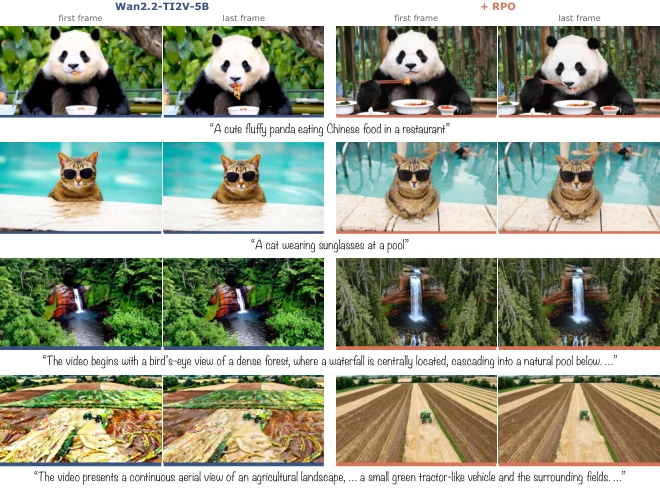
The authors publish generated comparison samples, including the paper figure shown here. Their project’s replacement video gallery explicitly has no matching score data, so those clips should not inherit scores from an older gallery.
At review, training code and evaluation outputs remain planned, and a MiniMax-H3 comparison is marked coming soon. The available evidence covers SD3.5 and Wan2.2; it does not establish a released installation package, downloadable trained checkpoints or validated results on a third generator. AITrending reviewed the English paper and project page but has not reproduced the experiments.
Related reading
Speculative Forcing reports 1.58x faster video by letting tokens stop early
Google opens SynthID Detector site for checking AI media watermarks