Sage V2's roleplay tip is to tune the sampler before blaming the model
An older GGUF release gets a fresh community recommendation and revised guidance on repetition, character cards and 8 GB GPUs.
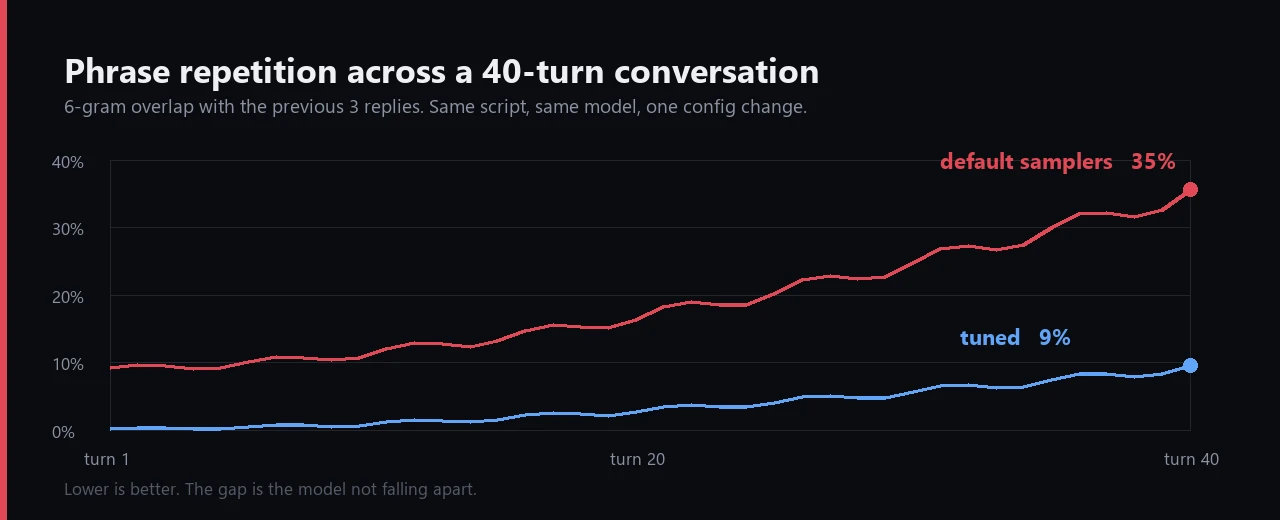
Sage V2’s most useful roleplay advice is about a setting, not a bigger model. In its revised English card, author sinhal says repetition penalty made the biggest quality difference in testing, recommending repeat_penalty: 1.08 instead of leaving it at 1.0. The accompanying chart compares the same model and conversation script with different sampler configuration. It should not be read as proof that fine-tuning alone produced the improvement.
The 8B Llama 3.1-derived roleplay model appeared in an October 26 English recommendation by Alizeh, whose follow-up directly links its Hugging Face repository. Its card was rewritten October 27 and updated October 28. That is evidence of a recent recommendation and renewed presentation, not a new weight release or measured growth: the repository history dates the GGUF upload to October 6.
For readers trying local character chat, the recipe is concrete. The author suggests temperature 0.95, min_p: 0.05 and repetition penalty 1.08, with DRY settings as another option where the frontend supports them. The card documents llama.cpp serving, SillyTavern Chat Completion with a Llama-3 Instruct template, and an Ollama Modelfile. It warns against baking literal {{char}} placeholders into Ollama’s system block, where they can pass through rather than becoming a character name.
The hardware recommendation is Q6_K for an 8 GB GPU. In the author’s RTX 4060 Laptop test, that file fully offloaded the model’s layers and ran faster than Q8_0, which partly spilled to the CPU. Q4_K_M is offered for more context headroom. This is one documented setup, not a guarantee that every 8 GB machine will fit the same context or achieve the same speed.
The card also reports a 40-turn repetition comparison and five-character dialogue examples. Those are author-run demonstrations, not an independent AITrending test, and lexical overlap does not establish general long-conversation reasoning. The author lists single-source synthetic training data, verbose answers and limited reasoning depth among the limitations. The weights use the Meta Llama 3.1 Community License; the card’s refusal-free promotional language is an author claim, not a verified universal behavior.