RoAR-VAE pitches an open FLUX.2-comparable recipe by teaching noisy latents to recover detail
Tsinghua and Microsoft Research authors report better generation scores and small-text reconstruction, while training code and checkpoints remain coming soon.
RoAR-VAE’s authors are pitching an open recipe for a visual tokenizer comparable to FLUX.2-VAE, with a simple central idea: useful image information should survive noisy latents. The October 19 paper from Tsinghua University and Microsoft Research pairs semantic prediction with recovery of image details, targeting the representation that a diffusion model learns from.
The practical attraction is better image generation without sacrificing the tokenizer’s ability to reconstruct its input. The paper reports an average generation benchmark improvement of 2.19 points over its strongest baseline tokenizer under the same training budget, and a 16.93-percentage-point improvement in small-text reconstruction accuracy over FLUX.1-VAE. Those are the authors’ reported comparisons, not independent AITrending measurements. The small-text comparison is against FLUX.1-VAE; it should not be relabeled as a quantified win over FLUX.2-VAE.
Predict meaning and pixels through the noise
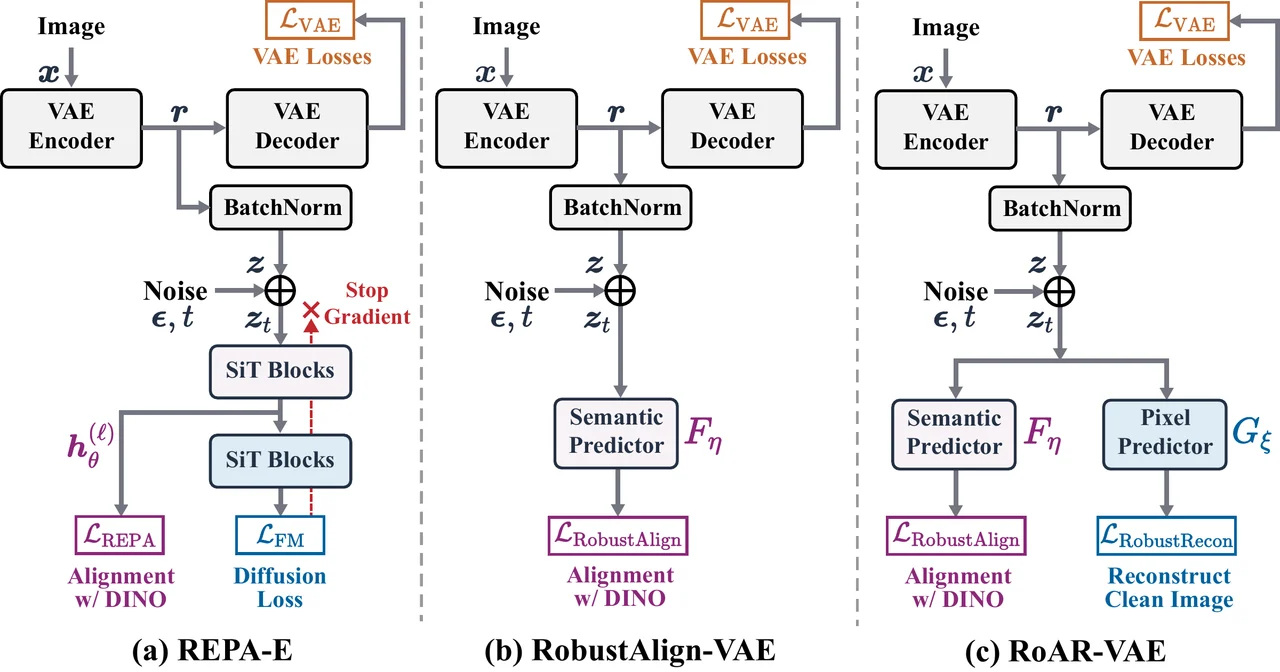
The researchers revisit REPA-E, a joint tokenizer-and-diffusion training approach. In their matched setting, removing its diffusion objective and dedicated generative blocks while keeping semantic prediction from corrupted latents produces comparable downstream generation performance. They call that simplified component RobustAlign.
RoAR-VAE adds RobustRecon, which predicts the clean image from noisy latents. The combination aims to preserve both high-level structure and the textures, boundaries and other fine details that semantic features can miss. The authors propose that making useful information accessible in high-variance latent directions helps diffusion models learn it earlier. Their published method diagram illustrates this training design; it is not a benchmark result or an independently reproduced output.
A research recipe, with downloads still pending
The project’s English overview uses the phrase “An open recipe for a VAE comparable to FLUX.2-VAE.” That is the team’s framing of its research, rather than a claim of identical quality across every prompt or deployment.
There is also an immediate availability distinction. Although the arXiv abstract links to the code repository, the reviewed README says training code, inference code and pretrained checkpoints are coming soon. Readers can inspect the paper and author figures now; the page does not yet supply a released checkpoint or an installation workflow. This is a new research proposal and reported evaluation, not a ready-to-install replacement for an existing image-generation pipeline.
Related reading

TorchNeuron brings native PyTorch to Trainium, with public beta due October 20
Maxwell claims nearly 2x faster LTX-2.5 video generation